
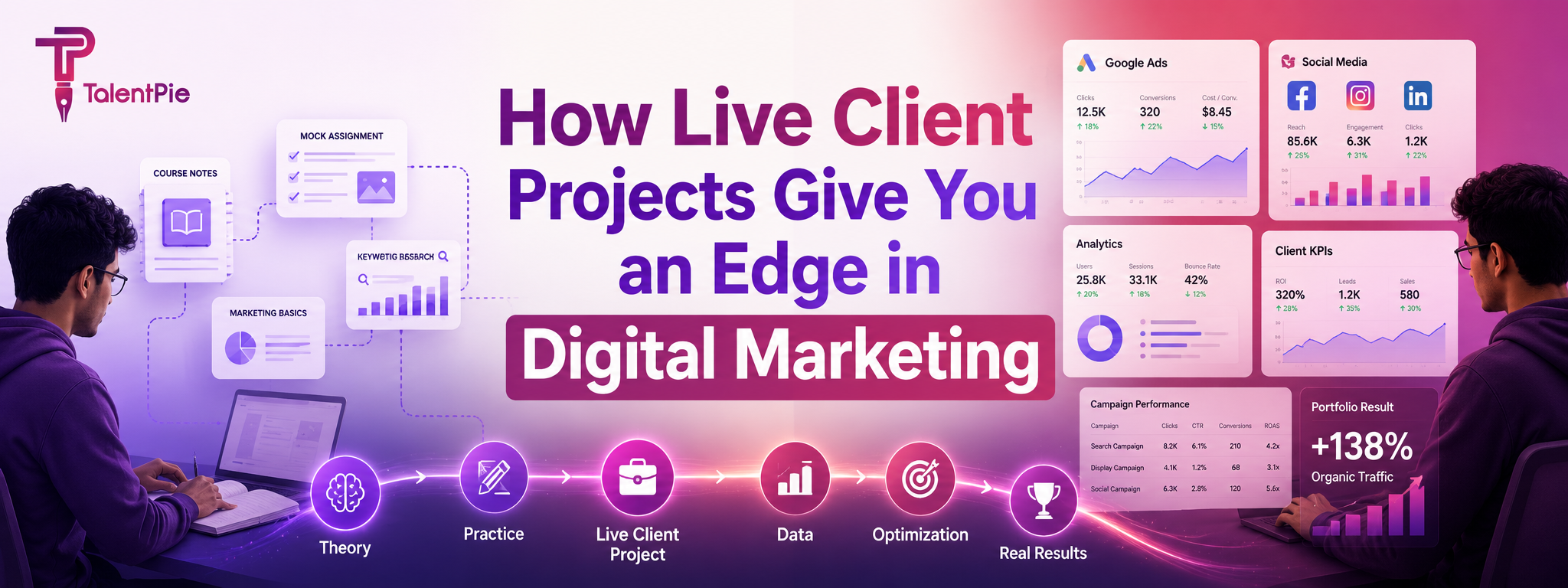
How Live Client Projects Give You an Edge in Digital Marketing
Anyone can learn what a keyword is, how a sales funnel works, or what CTR stands for. That's not the hard part. The hard part is deciding which keywords actually deserve budget when a client has three months of runway, or explaining to a business owner why their Instagram engagement looks great but sales haven't moved. This is exactly where live client projects in digital marketing separate people who understand the subject from people who can apply it under real conditions - with real audiences, real money, and real consequences attached to every decision.
Most digital marketing courses do a reasonable job teaching concepts. Far fewer put learners in a position where they have to make a judgment call and then watch what happens. This article looks at why that difference matters, and walks through seven specific advantages that come from working on actual client work instead of simulated exercises.
What Are Live Client Projects in Digital Marketing?
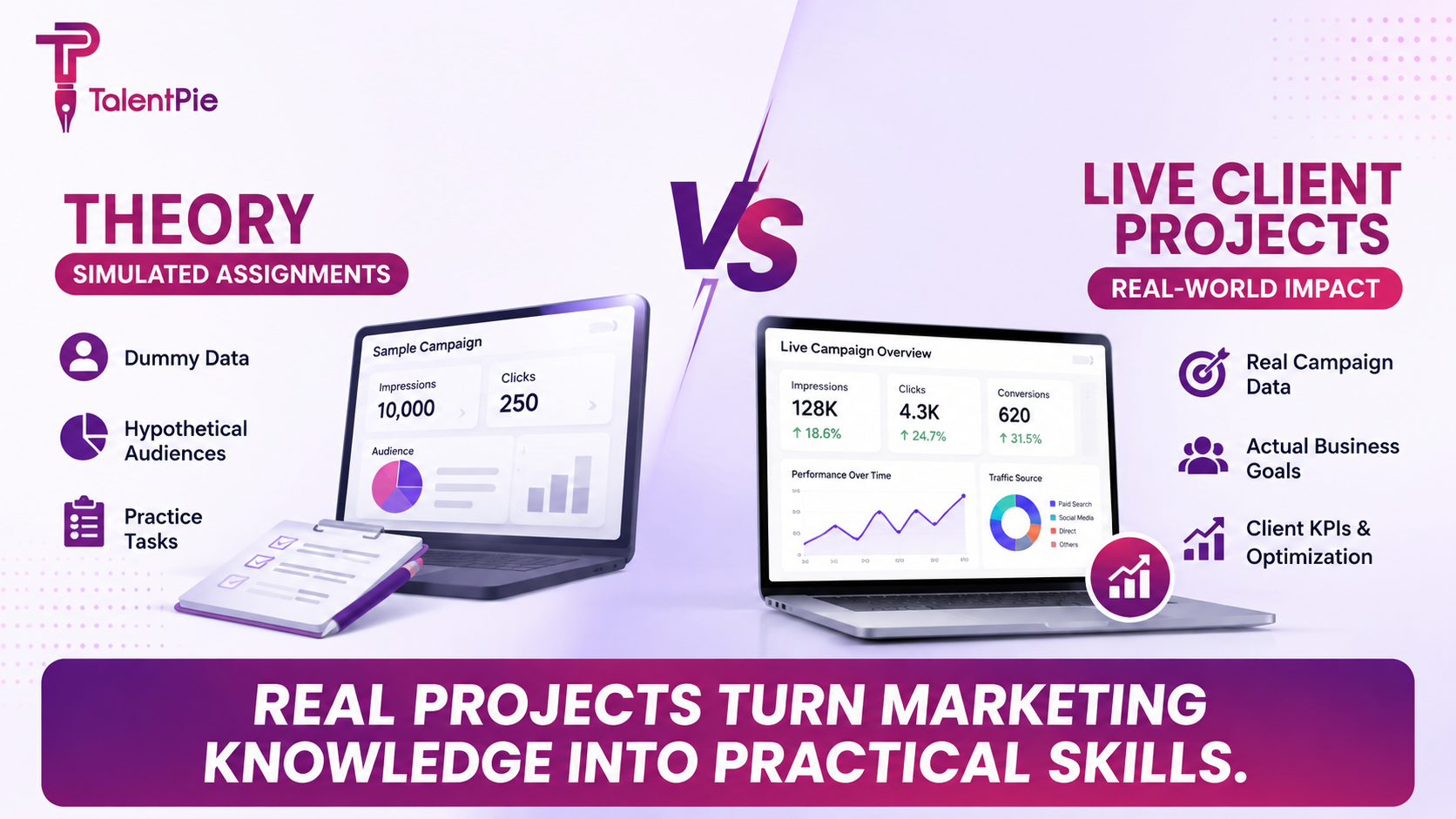
A live client project is work done for an actual business - a real website, a real social media presence, or a real ad account - where the outcomes matter to someone beyond the person doing the assignment. Instead of practicing on a mock scenario built for a lesson, you're solving a problem for a business that has genuine goals, a limited budget, and an actual audience it's trying to reach.
Live Projects vs Practice Projects
The distinction becomes clearer once you compare the two side by side.
A practice project usually involves a dummy website, or a spreadsheet of sample data someone created for the exercise. The "audience" is hypothetical - a persona invented for the assignment rather than people who actually exist and behave in unpredictable ways. Deadlines are set by a course schedule, and the outcome is graded against a rubric.
A live client project replaces every one of those with something less forgiving. There's a real website with existing content, existing technical issues, and an existing search presence you didn't create. The data reflects actual visitor behavior, not numbers chosen to illustrate a concept. The audience is whoever actually searches for, clicks on, or ignores the business. Deadlines come from the client's calendar, not a syllabus. And instead of a grade, the result is measured against business KPIs - traffic, leads, conversions, or revenue - which don't care whether your reasoning was sound on paper.
What Makes a Client Project "Live"?
A handful of characteristics separate a genuinely live project from something that just resembles one. There's a real business with real constraints - a budget ceiling, a brand voice it can't deviate from, or a market it can't ignore. There's a real marketing objective behind the work, whether that's more qualified leads, better organic visibility, or improved ad efficiency.
The project also involves a real website or social presence you're working within, not building from scratch as an exercise. Campaign data comes from actual traffic and actual spend. Performance tracking happens continuously, not at the end of a module. Reporting has to be understandable to someone who isn't a marketer. And optimization is ongoing - you don't finish a live client project so much as you keep adjusting it based on what the data shows.
This is what people usually mean by live client project training or a digital marketing live project: not a single assignment, but an ongoing relationship between strategy, execution, and results.
Why Live Client Projects Matter in Digital Marketing
The value isn't just "more practice." It's that live work changes how learning actually happens.
They Turn Digital Marketing Theory Into Practical Skills
Classroom learning tends to move in one direction: you learn a concept, then maybe apply it once in an exercise. Live projects create a loop - theory, implementation, feedback, and optimization - that repeats continuously and forces refinement.
Take keyword research. In theory, you learn to look at search volume, keyword difficulty, and relevance, then pick the "best" keywords. In a live project, you're often working with a business that can't realistically compete for the highest-volume terms because a handful of established competitors already dominate them. You have to decide between a lower-volume keyword the business can actually rank for within a reasonable timeframe, or a longer-term push for a competitive term with no guarantee of success. That's not a decision a textbook prepares you for - it's a trade-off you learn by making it, seeing the outcome, and adjusting.
They Teach You How to Work With Real Data
Live projects put you in regular contact with metrics like organic traffic, impressions, clicks, click-through rate, conversions, cost per click, engagement, leads, return on investment, and conversion rate. Knowing the definitions isn't the point. The point is learning what the numbers are telling you to do next.
A high CTR with a low conversion rate might mean the ad promises something the landing page doesn't deliver. Rising impressions with flat clicks might mean the copy needs work, not the targeting. You start using data less as a report card and more as a diagnostic tool - something that tells you where to look next, not just how you did.
They Develop Problem-Solving Skills
Real campaigns misbehave in ways that assignments rarely simulate. Organic traffic drops without warning. A keyword that was ranking on page one quietly slides to page three. Ads generate plenty of clicks but almost no conversions. A landing page gets decent traffic but barely any leads. Social engagement, which had been climbing steadily, suddenly flattens out.
None of these situations come with an obvious cause attached. A marketer working on a live project has to investigate - check Search Console for crawl errors or manual actions, look at whether a competitor recently improved their content, review whether tracking is even working correctly before assuming the campaign itself failed. That habit of investigating before reacting is one of the more transferable skills a live project builds, and it's difficult to develop from a static exercise where the "problem" is scripted in advance.
7 Ways Live Client Projects Give You a Competitive Edge

1. You Gain Real-World Digital Marketing Experience
Experience, in this context, doesn't just mean "you did the task." It means you made decisions under uncertainty - which platform to prioritize with a limited budget, which technical fix to tackle first, how to sequence a content plan when there isn't time to do everything at once. You also learn how individual marketing activities connect to a business objective, rather than existing as isolated tasks.
2. You Build a Portfolio With Actual Work
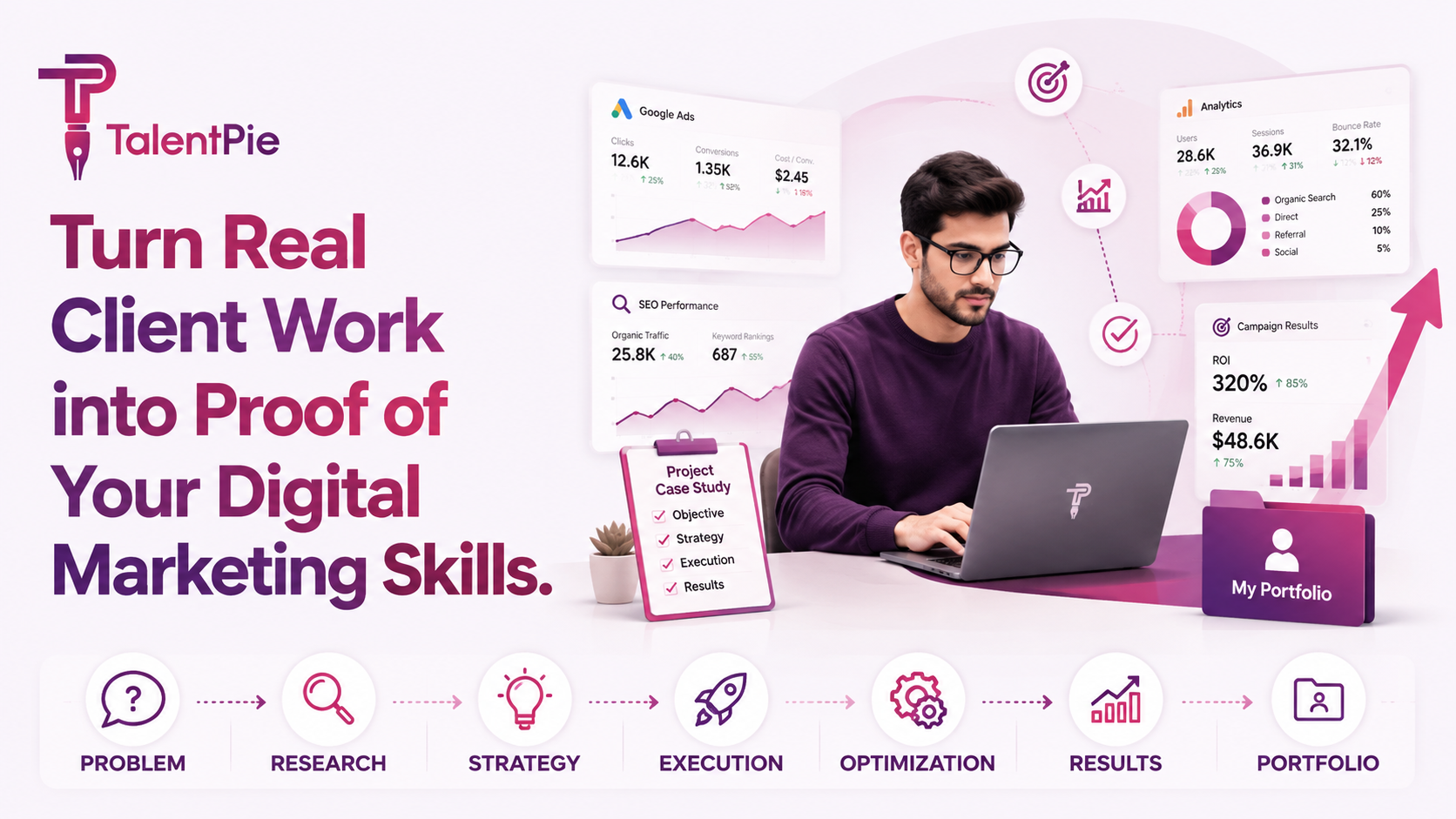
A portfolio built on live projects can show the full arc: problem, research, strategy, execution, optimization, result, and what you learned along the way. That's a fundamentally different kind of evidence than a certificate or a mock project, because it demonstrates reasoning, not just output.
There's a responsible way to do this. You don't need to publish confidential client data, exact revenue figures, or anything covered by an NDA. You can describe the approach, the type of business, the strategy you used, and general performance trends - enough to show your thinking without exposing information that isn't yours to share. This is the foundation of a credible digital marketing portfolio.
3. You Learn How to Handle Client Expectations
This part of the work rarely gets discussed honestly. Understanding what a client actually needs - as opposed to what they initially ask for - takes practice. So does setting expectations that are realistic instead of comforting, explaining why a recommendation makes sense in terms the client cares about, and reporting progress in a way that doesn't oversell early results.
It isn't always smooth. Clients change priorities mid-project. They sometimes push back on recommendations that are technically correct but inconvenient. Learning to navigate that - clarifying, negotiating, and occasionally holding your ground on something you believe is right - is part of what live client projects teach that a simulated assignment simply can't.
4. You Become Better at Data-Driven Decision Making
In a classroom setting, it's easy to say "I think this approach will work" and move on, because there's no real cost to being wrong. In a live project, that sentence has to become something closer to "the available data suggests this is worth testing," followed by an actual test and a measured result.
This shift matters. It pushes marketers toward experimentation — testing a headline, a targeting segment, or a content format on a small scale before committing a full budget to it - and toward treating measurement as part of the strategy, not something that happens after the strategy is finished.
5. You Learn Industry-Standard Digital Marketing Tools
Live projects are usually where tools stop being something you clicked through in a demo and start being something you rely on to make a decision.
Google Search Console shows how a site is actually performing in search - which queries bring traffic, which pages have indexing issues, and where visibility is dropping. Google Analytics 4 helps you understand what visitors do once they arrive, and where they drop off. Google Ads and Meta Ads Manager are where budget allocation, targeting, and bidding decisions actually get made and tested. Ahrefs and Semrush are typically used for competitor research and backlink analysis, helping you understand why a competitor outranks your client. Screaming Frog crawls a site the way a search engine does, surfacing technical issues like broken links or duplicate content. Looker Studio is where scattered data gets turned into a report a client can actually read and act on.
Using these tools to answer a real question - not just to complete a tutorial - is what makes the learning stick.
6. You Learn to Work With Deadlines and KPIs
Assignment deadlines are usually arbitrary. Client deadlines aren't - they're tied to a product launch, a seasonal sales window, or a reporting cycle the business has to answer to. Live projects introduce that pressure honestly, along with KPIs that are set by business goals rather than a grading rubric.
This forces a different kind of prioritization. If a client needs measurable movement in six weeks, you can't spend three of those weeks on a comprehensive audit with no visible output. You learn to sequence work so that early activity produces something reportable, while longer-term strategy continues in the background.
7. You Become More Confident in Interviews and Client Meetings
Live client experience doesn't guarantee a job offer, and it's worth being upfront about that - hiring decisions depend on many factors, and no single credential automatically outweighs the rest. What it does provide is something concrete to talk about.
Instead of describing digital marketing concepts in the abstract, you can walk through an actual situation: what problem existed, what research you did, what strategy you chose and why, what you implemented, what changed as a result, what the data showed, and what you'd do differently next time. That level of specificity is usually more persuasive than a general statement about being "passionate about marketing," simply because it's evidence rather than a claim.
How Live Client Projects Improve Different Digital Marketing Skills
SEO
A live SEO project typically starts with keyword research and a competitor analysis, followed by a technical SEO audit to catch crawlability or indexing issues. From there, on-page optimization and internal linking get addressed, content gets optimized for search intent rather than just keyword presence, and Search Console data is reviewed regularly to see whether organic performance is actually moving. What makes this different from an exercise is that each of these steps depends on the others - you can't fix on-page issues effectively without first understanding what the technical audit revealed.
Paid Advertising
Campaign work in a live setting involves setting up campaigns around a real objective, choosing audience targeting based on who the business actually serves, writing ad copy that has to compete for attention, and allocating a budget that has real limits. Conversion tracking has to be verified, not assumed to work. A/B testing becomes a genuine decision-making tool rather than a theoretical concept, and metrics like CPC, CPA, and ROAS become the basis for whether a campaign continues, gets adjusted, or gets shut down.
Content Marketing
Writing for an actual business means starting with content research and search intent, not a generic topic list. A content brief has to reflect what the business actually offers, and SEO writing has to balance readability with search visibility. Performance measurement afterward - did the content rank, did it get engagement, did it lead to any action - closes the loop in a way that an academic writing assignment never does, because there's no external audience actually evaluating the piece.
Social Media Marketing
This involves building a content calendar around actual business events or promotions, researching an audience that genuinely exists rather than assuming one, testing different creative formats to see what performs, tracking engagement honestly even when it's underwhelming, and reporting results in a way that connects activity to outcomes.
Analytics
Working with GA4 and building dashboards in a live setting means dealing with real, sometimes messy data. Understanding which KPIs actually matter for a specific business, applying basic attribution logic, and analyzing conversions all become tools for making a recommendation - not just producing a report that sits unread.
Live Client Projects vs Traditional Digital Marketing Learning
|
Traditional Learning |
Live Client Projects |
|
Theory-focused |
Execution-focused |
|
Sample assignments |
Real business tasks |
|
Dummy data |
Actual campaign data |
|
Limited feedback |
Continuous feedback |
|
Certificate-focused |
Portfolio-focused |
|
Fixed problems |
Real problems |
|
Academic deadlines |
Client deadlines |
|
Basic tool exposure |
Practical tool usage |
|
Exam-based evaluation |
Performance-based evaluation |
This isn't an argument that traditional learning is a waste of time. Understanding the fundamentals - how search engines rank content, how auctions work in paid advertising, how attribution models function - still needs to happen somewhere, and it's usually more efficient to learn it in a structured way first. Live projects don't replace that foundation; they add an execution layer on top of it, which is where a lot of the real learning tends to happen.
How to Get Maximum Value From a Live Client Project
Start With the Client's Business Goal
A useful sequence to follow is: business goal → audience → funnel → marketing objective → SEO/Ads/content strategy → KPI. Jumping straight into keyword research or ad creation without understanding the actual goal usually produces work that's technically sound but strategically misaligned.
Document Your Starting Point
Before making changes, record the baseline - existing traffic, current rankings, lead volume, conversion numbers, engagement levels, existing content, and any known technical issues. Without this, it's impossible to credibly show what changed later.
Create an Action Plan
Prioritize instead of attempting everything at once. A short list of high-impact actions, sequenced sensibly, tends to produce better results than a scattered attempt to fix every issue simultaneously.
Track Changes and Results
Keep a record of what changed and when. This matters not just for reporting to the client, but for your own understanding of cause and effect - if three things changed in the same week and traffic moved, you won't know which one mattered without a log.
Document What Worked and What Didn't
A test that failed still tells you something. Documenting a strategy that didn't produce the expected result, along with your reasoning for trying it, demonstrates a level of marketing thinking that only successes can't show on their own.
Turn the Project Into a Portfolio Case Study
The same framework applies again here: problem, research, strategy, execution, optimization, results, and learnings. Structuring the project this way after the fact turns ordinary project activity into something that reads as credible evidence of practical skill, rather than a vague description of "worked on SEO for a client."
What Should a Digital Marketing Live Project Portfolio Include?
For an SEO project, useful evidence includes the audit findings, keyword research, competitor analysis, the content strategy you built, specific optimization examples, and any ranking or traffic changes you can share responsibly.
For a Google Ads project, show the campaign objective, audience definition, budget structure, keyword or targeting choices, ad variations tested, CTR and CPC trends, conversion outcomes, and what you adjusted along the way.
For a social media project, include the content strategy and calendar, sample creatives, engagement and reach trends, and campaign results.
For an analytics project, a dashboard example, the KPIs you tracked, the insights you drew from the data, and the recommendations you made based on those insights are usually enough to demonstrate the thinking involved.
Across all of these, be mindful of confidentiality. Client names, exact revenue figures, and proprietary strategy details generally shouldn't be shared publicly without explicit permission, even if the underlying approach is worth showcasing.
Skills Recruiters Can See From Live Client Experience
Live project work gives you specific examples to point to for things that are otherwise hard to prove on a resume: SEO execution, analytical thinking, communication, reporting, problem-solving, campaign optimization, basic project management, client handling, tool proficiency, and an understanding of how marketing connects to business outcomes.
None of this guarantees a particular outcome in an interview - recruiters weigh many factors, and practical experience is one input among several. What it does is replace a vague claim ("I understand digital marketing") with a specific answer to a specific question, which tends to hold up better under follow-up questions.
Common Challenges in Live Client Projects and How to Handle Them
Live projects aren't uniformly smooth, and it's worth being honest about where they get difficult.
Fear of making mistakes is common, especially early on. This is usually addressed through controlled experimentation - testing changes on a smaller scale first, working under mentor supervision, and documenting decisions so mistakes become learning material rather than just failures.
Unexpected SEO or campaign performance - a sudden drop in traffic or a spike in cost per acquisition - should prompt diagnosis before action. Making random changes in response to a problem you haven't identified usually makes things harder to untangle later.
Difficult client requirements often come down to unclear priorities. Asking clarifying questions, proposing a prioritized plan, and managing expectations honestly tends to resolve more of these situations than simply agreeing to everything requested.
Limited data is a frequent reality, particularly with newer businesses or smaller budgets. Marketers learn to work with incomplete information, while being clear about the limitations of any conclusion drawn from it.
Tight deadlines require identifying which activities will actually move the needle and focusing there first, rather than spreading effort evenly across every possible task.
Managing multiple marketing channels at once can get scattered without a clear objective. A defined KPI framework helps keep SEO, paid, content, and social efforts pointed at the same outcome instead of working in isolation.
How to Choose a Digital Marketing Course With Live Projects
The phrase "100% live projects" appears in a lot of course marketing, and it's worth looking past the phrase itself. A more useful approach is to ask specific questions: Are the projects actually based on real businesses, or dressed-up templates? Do students work with real campaign data? Is there mentor supervision available when something goes wrong? Are the projects documented in a way that supports a portfolio afterward?
It also helps to check whether SEO, Google Ads, and Meta Ads are genuinely included, whether GA4 and Search Console are taught through practical use rather than just a walkthrough, and whether competitor research is part of the process. Beyond that, look for whether the program includes client communication practice, whether results are actually measured, and whether reporting and optimization are treated as ongoing parts of the work rather than a final step.
Live Client Projects and the Future of Digital Marketing Careers
Digital marketing in 2026 looks different from a few years ago. AI-assisted tools now handle a good portion of routine work - generating ad variations, drafting content outlines, automating bid adjustments, and surfacing data patterns faster than a person could manually. Search itself is evolving too, with answer engine optimization and generative engine optimization becoming relevant alongside traditional SEO, and performance marketing leaning more heavily on automation and personalization.
None of this reduces the value of understanding how marketing actually works - if anything, it shifts the value toward judgment. When a tool can generate ten ad variations in seconds, the differentiator becomes knowing which one actually fits the audience and the business goal, and being able to interpret what the resulting data means. As execution becomes easier to automate, the ability to solve real business problems - which is exactly what live client projects practice - becomes more relevant, not less.
Frequently Asked Questions About Live Client Projects in Digital Marketing
1.What is a live client project in digital marketing?
It's marketing work done for an actual business with a real website, real audience, and real performance goals, as opposed to a simulated exercise built for a course.
2.Why are live projects important in digital marketing?
They connect theoretical knowledge to real decision-making, using actual data, real constraints, and outcomes that carry genuine consequences.
3.Are live client projects better than theoretical digital marketing training?
They serve different purposes. Theoretical training builds the foundation; live projects add the execution and decision-making layer on top of it.
4.What skills can you learn from a digital marketing live project?
SEO execution, paid campaign management, content strategy, analytics interpretation, client communication, and problem-solving under real constraints.
5.Do live client projects help build a digital marketing portfolio?
Yes. They provide real evidence of a problem-to-result process, which is generally more convincing than a mock assignment or a certificate alone.
6.What tools are used in live digital marketing projects?
Commonly used tools include Google Search Console, Google Analytics 4, Google Ads, Meta Ads Manager, Ahrefs or Semrush, Screaming Frog, and Looker Studio.
7.Can beginners work on live client projects?
Yes, typically under mentor supervision, starting with smaller tasks and building toward more independent decision-making as skills develop.
8.How do live client projects improve job readiness?
They give candidates specific, real examples to discuss in interviews, rather than general statements about theoretical knowledge.
9.What should I include in a digital marketing project portfolio?
The problem you addressed, your research and strategy, what you executed, how you optimized it, and the results - shared responsibly without exposing confidential client data.
10.How is a live client project different from an internship?
A live client project is usually a defined, project-based engagement, while an internship tends to be broader and longer-term, often involving a mix of live work, observation, and general team responsibilities.