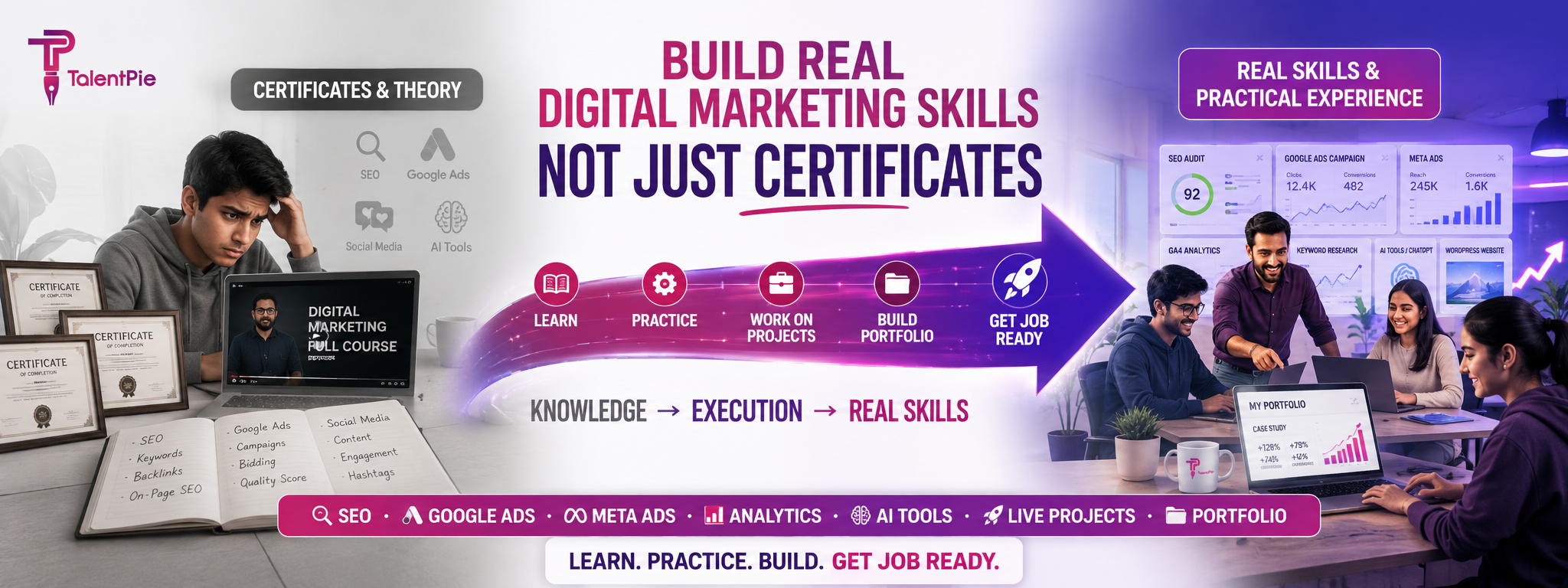
Build Real Digital Marketing Skills, Not Just Certificates
Picture this: a learner has four certificates sitting in a folder on their laptop. SEO, Google Ads, Social Media Marketing, maybe even one on "AI for Marketers." Then an interviewer asks a simple question - "Can you walk me through how you'd audit this website?" or "Here's a Google Ads account with a low CTR, what would you check first?"
Silence.
This happens more often than most people expect, and it's not because the learner didn't study. It's because certificates are proof of exposure, not proof of ability. Somewhere between finishing a course and sitting in front of a hiring manager, a gap opens up - and that gap is exactly what separates people who get hired from people who get shortlisted and forgotten.
This is the core idea behind learning to build real digital marketing skills instead of chasing one certificate after another. A certificate isn't worthless - it shows that someone made an effort to learn. But on its own, it doesn't show what a person can actually do with a live campaign, a confusing analytics dashboard, or a client who wants results, not theory.
Why Certificates Alone Don't Get You Hired
There's a meaningful difference between knowing about digital marketing and being able to execute it. A learner can watch twenty hours of video lessons on keyword research and still freeze when handed a real spreadsheet of search terms and asked to decide which ones are actually worth targeting. Knowledge answers "what is this?" Skill answers "what do I do with this, right now, for this business?"
Recruiters and hiring managers have gotten wise to this gap. A resume full of certificate logos used to be impressive; now it's often treated as a starting point rather than a deciding factor. What tends to move a candidate forward is evidence - a project, a decision they made and can explain, a mistake they caught and fixed.
The Skill Gap in Digital Marketing
The gap usually shows up in predictable places. A beginner might be able to define "search intent" in an interview but has never actually looked at a set of keywords and grouped them by what the searcher was trying to accomplish. Someone might know that Google Ads uses Quality Score, but has never built a campaign structure from scratch or written ad copy that had to compete against five other advertisers for the same click.
The same pattern shows up in social media. It's one thing to know that Instagram Reels get more reach than static posts; it's another to plan a month's content calendar for a business that sells, say, ayurvedic skincare, and decide what to post on a Tuesday versus a Saturday. Analytics tools are no different - plenty of learners can recite that GA4 tracks "engagement rate," but far fewer can open a real GA4 property and explain why traffic spiked last week or why a landing page has a high bounce rate.
Even AI tools, which are supposed to make marketing easier, create a new version of the same problem. A learner might know how to type a prompt into ChatGPT and get a blog outline, but not know whether that outline actually matches what the target audience is searching for, or how to fact-check and edit what the AI produced.
What Employers Actually Look For
Ask people who actually hire for digital marketing roles what stands out, and certificates rarely top the list. What comes up instead is closer to this: Can this person solve a problem when the obvious answer doesn't work? Do they understand the fundamentals of SEO and paid campaigns well enough to make a judgment call? Can they read a report and tell you what it means, not just what the numbers say? Can they write content that sounds like it was made for a real audience, not for a template? Can they explain, in plain language, why they made a particular decision on a campaign?
Communication matters more than people expect too. A marketer who can clearly explain to a business owner why a Google Ads campaign isn't converting - and what they plan to do about it - is more valuable than one who understands the theory but can't translate it into a conversation. In an interview, a candidate who says "here's an SEO audit I did for a local bakery's website, and here's what I changed" tends to leave a stronger impression than one who says "I have a certificate in SEO."
What Real Digital Marketing Skills Should You Learn?
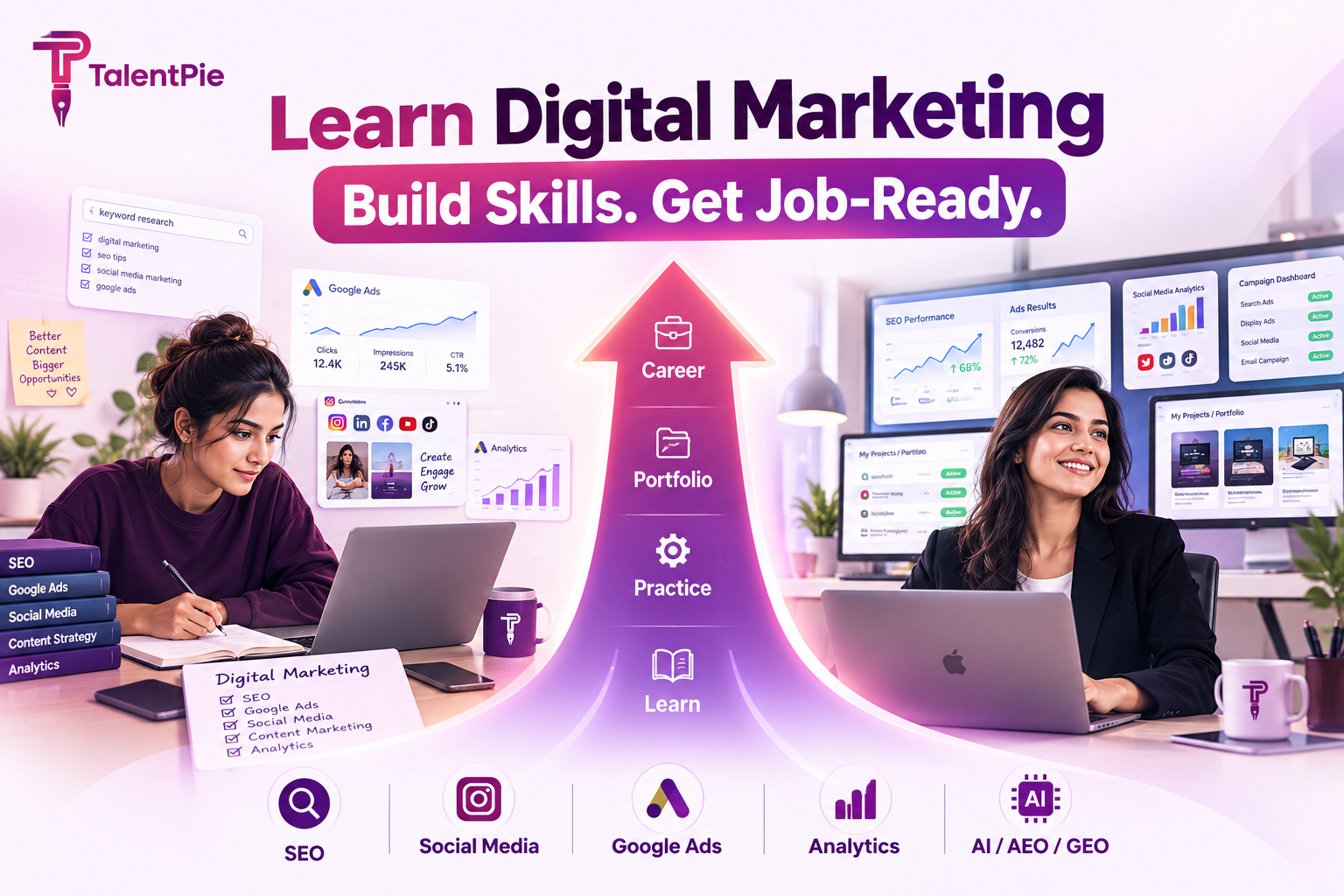
Digital marketing isn't one skill - it's a set of connected disciplines that work together. Trying to master all of them at once isn't realistic, especially for a beginner, but understanding what each one actually demands is a good starting point.
SEO (Search Engine Optimization)
SEO covers more ground than most beginners assume: keyword research, understanding search intent, on-page optimization, the basics of technical SEO, internal linking, content optimization, local SEO, and reporting on what's working.
The real skill isn't knowing what a keyword is - it's knowing what to do with a list of them. Take keyword research as an example. A beginner might pull up a tool, see that "digital marketing course" gets a high search volume, and assume that's the keyword to chase. A more experienced approach looks past the volume and asks who's actually searching that term, and whether they're a student comparing options, a parent researching for their child, or someone who already decided and is now just looking for the enrollment page. That's the difference between collecting data and using it - and it's a skill that only develops by actually working with real search data, not by reading about it.
Google Ads & PPC
Google Ads has a lot of vocabulary attached to it - Quality Score, CPC, CTR, conversion tracking - and it's easy to memorize the definitions without ever touching an actual account. Real skill here means being able to structure a campaign logically, choose keywords that match what a business is actually trying to sell, write ad copy that gives someone a reason to click, connect that click to a landing page that doesn't waste it, and set up conversion tracking so the business can tell whether any of it worked.
Understanding why a campaign decision was made matters more than being able to recite a definition. Knowing that Quality Score exists is trivia. Knowing that a low Quality Score is often caused by a mismatch between the ad copy and the landing page - and being able to fix that mismatch - is a skill.
Social Media Marketing
Social media looks deceptively simple from the outside, which is part of why it's often underestimated as a skill area. Real competence here includes planning content around a clear strategy, researching who the audience actually is, choosing the right platform for that audience, picking content formats that fit each platform, building engagement rather than just posting and hoping, and being able to measure whether any of it moved the needle.
Meta Ads
Meta Ads (Facebook and Instagram advertising) asks for a slightly different set of instincts than Google Ads, since the audience isn't actively searching - they're being interrupted mid-scroll. That means audience targeting has to be sharper, campaign objectives need to be chosen carefully depending on whether the goal is awareness or conversions, and creative testing becomes essential, since the same offer can perform completely differently depending on the image or video used. Budget allocation, retargeting logic, and reading conversion data all come into play once a campaign is live, and optimizing it over time is where a lot of the real learning happens.
Content Marketing & AI Tools
AI tools have genuinely changed how content marketing work gets done. They're useful for research, generating content ideas, building outlines, clustering keywords, producing ad copy variations, and speeding up data analysis and repetitive tasks.
What AI doesn't replace is judgment. A tool can generate ten headline options, but it can't tell you which one actually fits the brand's voice, or whether the claims in a piece of content are accurate, or whether the strategy behind the content makes sense for the business. Marketers who use AI well treat it as a way to move faster, not as a substitute for thinking. The learners who understand this distinction tend to produce noticeably better work than those who simply publish whatever the AI generates.
GA4 & Analytics
Analytics is where a lot of digital marketing decisions either get validated or fall apart. Understanding traffic sources, engagement, conversions, acquisition channels, user behavior, and overall campaign performance isn't just a reporting exercise - it's how a marketer figures out what to do next.
A beginner-friendly way to think about it: traffic tells you how many people showed up, engagement tells you whether they stuck around, and conversions tell you whether any of it actually mattered for the business. Being able to move between these three questions, using real data, is a far more useful skill than being able to define each metric in isolation.
How TalentPie Helps You Become Job-Ready
Understanding what skills matter is one part of the picture. Actually developing them requires a learning environment built around practice, not just instruction. This is the area TalentPie has structured its course around.
Live Client Projects
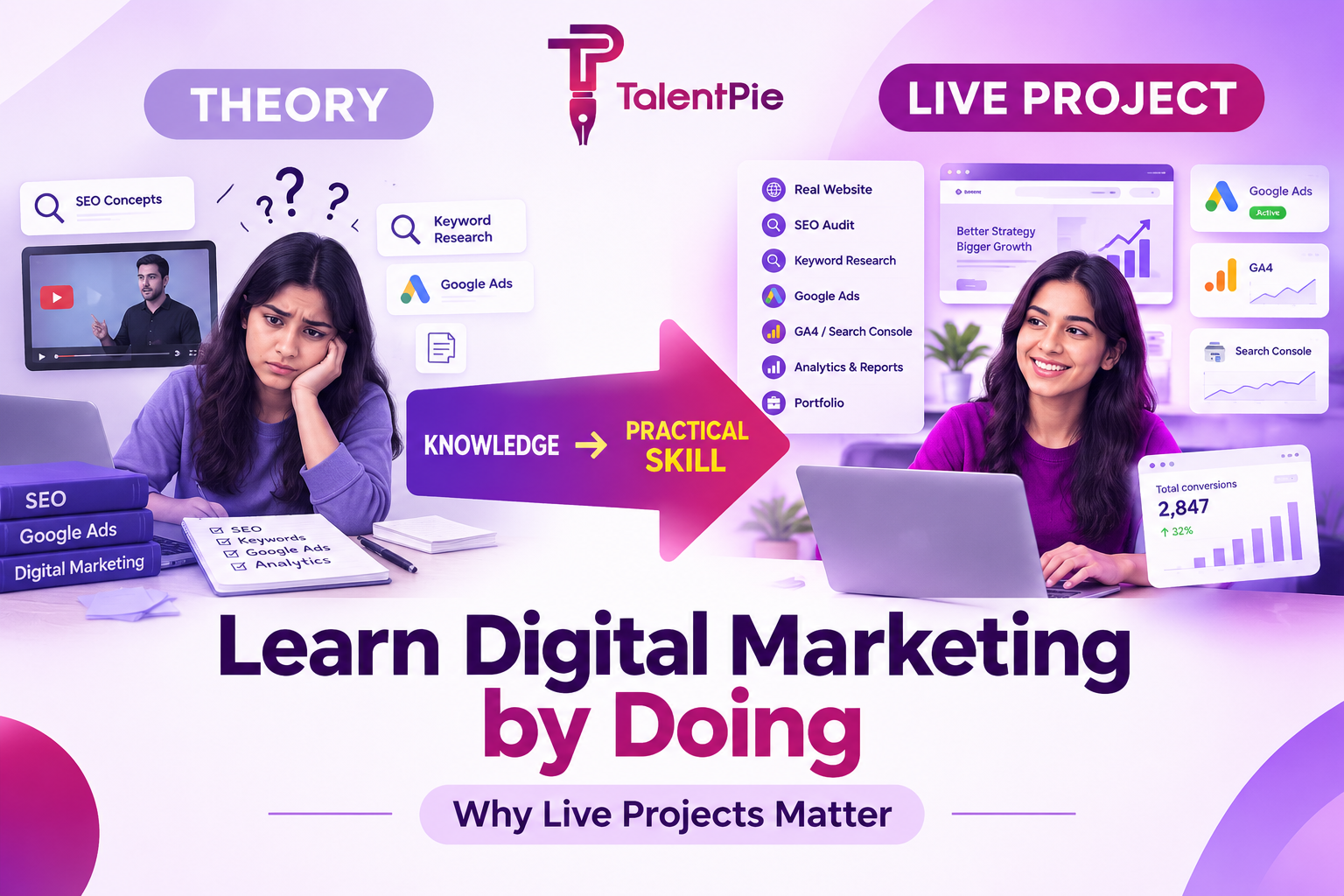
Working on live or realistic client campaigns exposes learners to things a textbook simply can't teach - real business objectives, actual deadlines, the back-and-forth of campaign decisions, reporting to someone who isn't grading an assignment but evaluating results, and the ongoing work of optimization. This kind of exposure is where theoretical knowledge starts turning into judgment.
1-on-1 Mentorship
Mentorship gives learners a way to catch mistakes before they become habits. A mentor can point out why a particular keyword strategy doesn't fit a business, or why an ad's messaging isn't landing, in a way that self-study rarely surfaces. It also gives learners a space to ask the kind of questions that don't have a clean textbook answer.
Internship Experience
An internship is often the bridge between "I learned this in class" and "I've actually done this for a real business." It's where a learner starts to understand the pace, expectations, and problem-solving that professional marketing work involves - without the pressure of already being expected to know everything.
Portfolio Building
By the end of a practical course, a learner should have something to show, not just something to claim. That could include an SEO audit of a real website, a keyword research project, a content brief, a Google Ads campaign plan, a social media content calendar, a Meta Ads campaign structure, an analytics report, or a short case study describing a decision and its outcome. A portfolio like this does something a certificate can't - it lets an employer see how someone thinks, not just what they've studied.
Why Choose a Digital Marketing Course in Noida?
For learners based in and around Noida, there are some practical advantages to training locally and offline, even though this isn't the right fit for everyone.
Offline Learning
Offline learning isn't automatically better than online learning - plenty of people learn well through recorded video and self-paced study. But for beginners who are still building discipline and confidence, being in a room with an instructor has real advantages: direct interaction, immediate feedback when something doesn't make sense, a structured schedule that builds accountability, and the chance to hear other learners ask questions you might not have thought of yourself.
Networking
Sitting in a classroom with other learners, trainers, and occasionally visiting industry professionals creates informal opportunities that online courses often can't replicate - a classmate who shares a job posting, a trainer who explains how a real agency handles a particular client situation, or a peer who becomes a collaborator on a future project.
Placement Support
Meaningful placement support isn't a guarantee of a job - no institute can honestly promise that. What it should realistically offer is resume guidance, interview preparation, portfolio review, mock interviews, help navigating the job search, and some exposure to how the industry actually operates. Learners evaluating any institute should ask specifically what "placement support" includes, rather than accepting the phrase at face value.
How to Choose the Best Digital Marketing Institute in Noida
With several institutes offering digital marketing training in Noida, it helps to have a clear checklist rather than relying on marketing claims alone. Before enrolling anywhere, it's worth evaluating:
- Whether the course includes real, hands-on projects - not just recorded lectures
- The trainers' actual industry experience, not just their job titles
- How current and structured the curriculum is
- Whether the course actively helps you build a portfolio
- Internship opportunities and what they actually involve
- Whether AI tools and current marketing platforms are part of the training
- How much time is spent on analytics, not just campaign creation
- The level of mentorship and one-on-one feedback available
- Batch sizes - smaller batches usually mean more individual attention
- What placement support genuinely includes
- Independent reviews and feedback from past learners
- Transparency about fees, duration, and realistic outcomes
No single institute is objectively "the best" for every learner - the right fit depends on your goals, learning style, and how much hands-on practice you're looking for. TalentPie's approach centers on live client projects, offline classroom learning, mentorship, and current AI tools, which may be worth considering if that combination matches what you're looking for.
Career Opportunities After Learning Digital Marketing
Once someone has built real, demonstrable skills, several entry-level career paths open up.
SEO Executive - Focuses on improving a website's organic visibility through keyword research, on-page optimization, content improvements, and reporting. A strong portfolio piece here is an SEO audit with clear before-and-after recommendations.
Digital Marketing Executive - A more generalist role that touches SEO, social media, content, and sometimes paid ads. Employers usually value versatility and the ability to manage multiple small tasks across channels.
PPC Executive - Manages and optimizes paid campaigns on platforms like Google Ads and Meta Ads. Skills in keyword selection, ad copywriting, and conversion tracking matter most here, and a sample campaign plan makes a strong portfolio addition.
Social Media Executive - Plans and manages content across platforms, handles community engagement, and reports on performance. A content calendar and a few sample creative concepts demonstrate this well.
Content Marketing Executive - Focuses on writing, content strategy, and increasingly, using AI tools responsibly to speed up research and drafting. A few well-researched sample articles or content briefs go a long way here.
Performance Marketing Executive - Works across paid channels with a strong focus on measurable results and ROI, requiring solid analytics skills alongside campaign management.
SEO Analyst / Digital Marketing Analyst - Leans more heavily into data - interpreting GA4 reports, tracking conversions, and identifying trends that inform strategy. Comfort with analytics tools and clear reporting are essential here.
A Note on Salary
Salary in digital marketing roles varies significantly based on experience, skill level, the hiring company, location, the specific role, the strength of a candidate's portfolio, and the industry they work in. Entry-level compensation tends to be modest and grows meaningfully as a professional builds a track record of real campaign work. Rather than relying on specific figures - which change often and vary widely by city and company - it's more useful for a fresher to focus on building demonstrable skills, since portfolio strength tends to have a direct impact on both job offers and negotiating power.
FAQs
1.Is a certificate enough to get a digital marketing job?
A certificate can support your profile, but on its own it rarely tells an employer what you can actually do. Pairing certificates with practical projects, a portfolio, and hands-on experience makes a much stronger case.
2.Which is the best digital marketing course in Noida?
Rather than looking for a single "best" answer, compare institutes based on hands-on training, trainer experience, portfolio support, internship opportunities, and honest reviews. TalentPie is one option worth evaluating against this checklist, particularly if live client projects and offline mentorship matter to you.
3.What skills should a fresher learn first?
A solid starting foundation includes SEO basics, Google Ads fundamentals, social media marketing, content marketing, analytics, and familiarity with common AI tools. You don't need to master all of these at once - building a working understanding of each, then going deeper over time, tends to work better than trying to specialize immediately.
4.Does TalentPie provide practical training?
Based on its course structure, TalentPie focuses on live client projects, hands-on assignments, current AI tools, one-on-one mentorship, internship experience, and portfolio development.
5.How long does it take to learn digital marketing?
This depends on the depth you're aiming for. A working foundation across the core channels can be built in a few months of consistent, hands-on learning, but genuine proficiency - the kind that shows up in interviews and on the job - usually develops over a longer stretch of real practice and project work.
6.Can I learn digital marketing without a technical background?
Yes. Most core digital marketing skills - SEO, content, social media, campaign management - don't require a coding or technical background to get started. Some areas, like technical SEO or analytics, involve a learning curve, but they're approachable with consistent practice.
7.Is digital marketing a good career for freshers?
It can be, particularly for people who enjoy a mix of creativity, data, and problem-solving. Like most fields, outcomes depend heavily on how much practical skill and demonstrable work a fresher builds, rather than on the field itself.
Conclusion
Certificates aren't the enemy here - they show effort, and effort counts for something. But they were never designed to prove capability on their own. The learners who stand out are the ones who can answer a different set of questions: Can I audit a website? Can I build a campaign from scratch? Can I look at a set of numbers and tell you what they mean? Can I put together a content strategy that makes sense for a specific business? Can I explain the reasoning behind my decisions? Can I actually show my work?
If you're looking for practical digital marketing training in Noida, it's worth exploring TalentPie's course structure, its project-based learning approach, and its mentorship options before making a decision - alongside any other institute you're considering.