Learn Digital Marketing by Doing: The Power of Live Projects
Someone finishes a stack of SEO tutorials. They know what keyword research means, they've watched hours of Google Ads walkthroughs, and they can recite the difference between reach and engagement without blinking. Then they're handed an actual website - a real one, with real traffic problems and a client who wants results - and they freeze. Where do you even start? Which keyword actually matters? Why isn't the campaign converting when everything looks "correct" on paper?
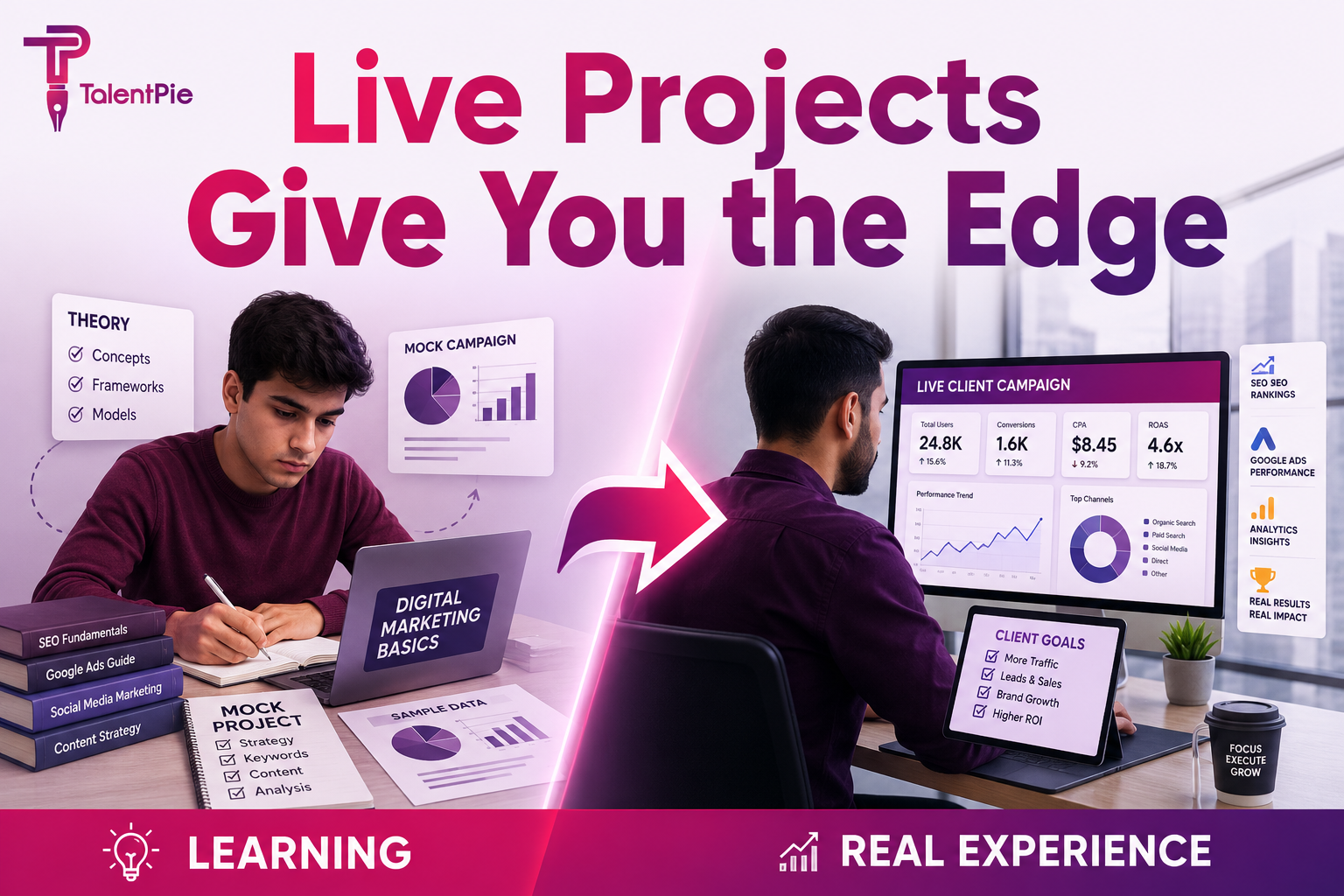
That gap between knowing and doing is exactly where most digital marketing learners get stuck. Watching a demo is not the same as running a campaign. Reading about audits is not the same as opening a website and finding what's actually broken. This is where digital marketing live projects change the equation - they force a learner to turn scattered knowledge into decisions, execution, and job-ready skills, not just a mental checklist of terms.
Why Learning Digital Marketing Is Different From Doing Digital Marketing
There's a quiet assumption a lot of beginners make: if I understand a concept, I can apply it. In digital marketing, that assumption falls apart fast.
Understanding SEO and auditing a live website are two different skill sets. Watching someone build a Google Ads campaign and actually structuring one - choosing match types, setting budgets, deciding what to track - require a different kind of thinking. Reading a Google Analytics dashboard is easy when someone else has already labeled what matters. Interpreting that same dashboard when nobody tells you which number is the problem is a completely different exercise.
Theory Gives You Knowledge
Courses, videos, and articles are good at transferring information. A learner can walk away knowing that meta descriptions influence click-through rate, that bounce rate isn't always a bad sign, or that A/B testing helps compare ad creatives. That's useful groundwork. But knowledge on its own doesn't tell you what to do first when three things are wrong with a website at once.
Projects Turn Knowledge Into Skills
A live project takes that same knowledge and puts it under pressure. Instead of "meta descriptions matter," the question becomes: which ten pages on this specific site need new meta descriptions, and why these ten first? That single shift - from general rule to specific decision - is what separates a learner who has studied digital marketing from one who can actually practice it.
Real Execution Builds Confidence
There's also a psychological side to this. Someone who has only read about running a Meta Ads campaign will hesitate the first time a real budget is involved. Someone who has already made that decision once, even in a training environment, walks into an interview or a job with a very different level of comfort. Confidence in marketing rarely comes from more reading. It comes from having already done the thing once and survived the mistakes.
What Are Digital Marketing Live Projects?
A digital marketing live project is hands-on work on a real (or realistically structured) website, brand, or campaign, where a learner actively researches, plans, executes, and analyzes results - rather than simply observing someone else do it.
The word "live" is doing a lot of work in that definition, and it's worth being precise about it, because not every course that uses the term means the same thing.
Watching a mentor perform a keyword research session on screen is a demonstration. Completing a worksheet that asks you to "list five keywords for a bakery" is a theoretical assignment. Working through a pre-built, fictional case study with no real data attached is a simulated project - useful, but not the same thing. A genuine live project involves an actual website, a real (or client-style) business context, real tools like Google Search Console or GA4, and outcomes that can actually be measured.
The important distinction isn't just "is the website real." It's whether the learner is the one making decisions - choosing which keywords to target, deciding what to fix first in an audit, setting up the campaign structure - rather than following a script someone else already finished.
Why Live Projects Are Important for Learning Digital Marketing
You Learn How to Solve Real Marketing Problems
Textbook examples are clean. Real websites are not. A page might rank for the wrong keyword, have thin content, and suffer from slow load times all at once. A live project forces a learner to prioritize - which problem, if fixed, actually moves the needle first - instead of applying fixes in the order a course module happened to teach them.
You Understand the Complete Marketing Workflow
In a course video, SEO, content, and analytics are usually taught as separate chapters. In a live project, they collide. A content brief has to be informed by keyword research. A campaign's performance has to be checked against the conversion tracking that was set up earlier. Learners start to see how one stage of marketing feeds into the next.
You Learn From Mistakes
Set a Google Ads audience too broad, and cost-per-click climbs while conversions barely move. Publish content optimized for the wrong search intent, and traffic comes in but doesn't convert. These mistakes, made once in a supervised environment with mentor feedback, teach faster than any slide deck. Theoretical learning tends to avoid mistakes by design. Practical digital marketing training doesn't - and that's precisely its value.
You Develop Problem-Solving Skills
A live project rarely has one obvious "correct" answer. Should this page target a high-volume keyword with tough competition, or a lower-volume one that matches user intent more closely and converts better? There isn't a single textbook answer - there's a judgment call, backed by data and reasoning. That's the kind of thinking employers actually want.
You Build Work Samples for Your Portfolio
An audit report, a keyword mapping sheet, a campaign structure document - these become tangible proof of ability. "I understand SEO" is a claim. A real audit with findings and fixes is evidence.
You Become More Comfortable With Marketing Tools
Reading about Google Search Console is not the same as noticing, inside the actual dashboard, that a set of pages has a sudden dip in impressions and having to figure out why. Repeated exposure to the real interface - not screenshots in a slide - is what makes someone tool-comfortable rather than tool-aware.
What Can You Learn Through a Digital Marketing Live Project?
SEO and Keyword Research
This usually starts with identifying what a business's pages should rank for, not just what has high search volume. A learner researches keywords, checks search intent - is someone looking to buy, compare, or just learn? - studies what competitors are already ranking for, and maps chosen keywords to specific pages. On-page elements like titles, headers, and internal linking get evaluated, and technical issues (broken links, indexing problems, slow pages) get flagged using tools like Google Search Console.
A keyword with high search volume is not automatically the best keyword. A learner working on a real project has to weigh intent, relevance, competition, and business value before deciding which page should target it.
Content Marketing
Here the work moves from "write a blog post" to building an actual content plan: which topics matter to the target audience, how they map to keywords already identified, and what a content brief needs to include before a writer starts. Published content then gets checked for how it performs - does it bring traffic, does that traffic stay on the page, does it lead anywhere useful.
Social Media Marketing
This isn't just posting content on a schedule. It includes researching what the target audience actually engages with, building a content calendar with a reason behind each post, working with creatives, and reviewing engagement data afterward to see what resonated and what fell flat.
Performance Marketing
Running a Google Ads or Meta Ads campaign in a live setting means thinking through campaign structure, choosing how to target the right audience, setting up conversion tracking so results can actually be measured, and then optimizing based on what the numbers show - not on assumption.
Knowing what Google Ads is and knowing how to structure a campaign, set up tracking, read performance metrics, and decide what to change next week are two very different levels of understanding.
Analytics and Reporting
GA4 and Search Console data only matter if someone can interpret them. A live project usually asks a learner to track traffic, rankings, click-through rate, and conversions over time, then put that into a report that explains what happened and why - a skill that's directly used in actual marketing jobs.
How a Digital Marketing Live Project Works
This is where the real learning happens, and it's worth walking through in detail because "live project" means very little without understanding the actual stages a learner moves through.
- Understand the Business and Audience
Before touching a single tool, the learner needs to know who the business serves, what it sells, and who the target customer actually is. Skipping this step is the most common beginner mistake - you can't choose the right keywords or campaign angle without knowing who you're speaking to.
- Conduct a Digital Marketing Audit
This is where existing gaps get identified - technical SEO issues, weak content, missing conversion tracking, underperforming social channels. The learner reviews the current state, prioritizes what matters most, and typically produces an audit document as a deliverable.
- Perform Keyword and Competitor Research
Relevant search terms get collected, evaluated for intent, and checked against what competitors already rank for. The output here is usually a keyword mapping sheet - which terms go to which page, and why.
- Create the Marketing Strategy
With the audit and keyword research in hand, the learner puts together an actual plan: which pages need work, what content should be created, how campaigns should be structured, and in what order things should happen.
- Execute SEO, Content, Social, or Paid Campaigns
This is the implementation stage - making on-page changes, publishing content, setting up or adjusting ad campaigns, scheduling social posts. It's the point where strategy stops being a document and starts being visible work.
- Track Performance
Once changes are live, the learner monitors what's happening - rankings, organic traffic, click-through rate, ad spend efficiency, leads generated - using tools like GA4 and Search Console.
- Optimize Based on Data
The final and arguably most important stage. What worked? What didn't? Should the budget shift to a better-performing ad set? Does a page need another content update? This is where campaign optimization becomes a repeatable habit rather than a one-time task.
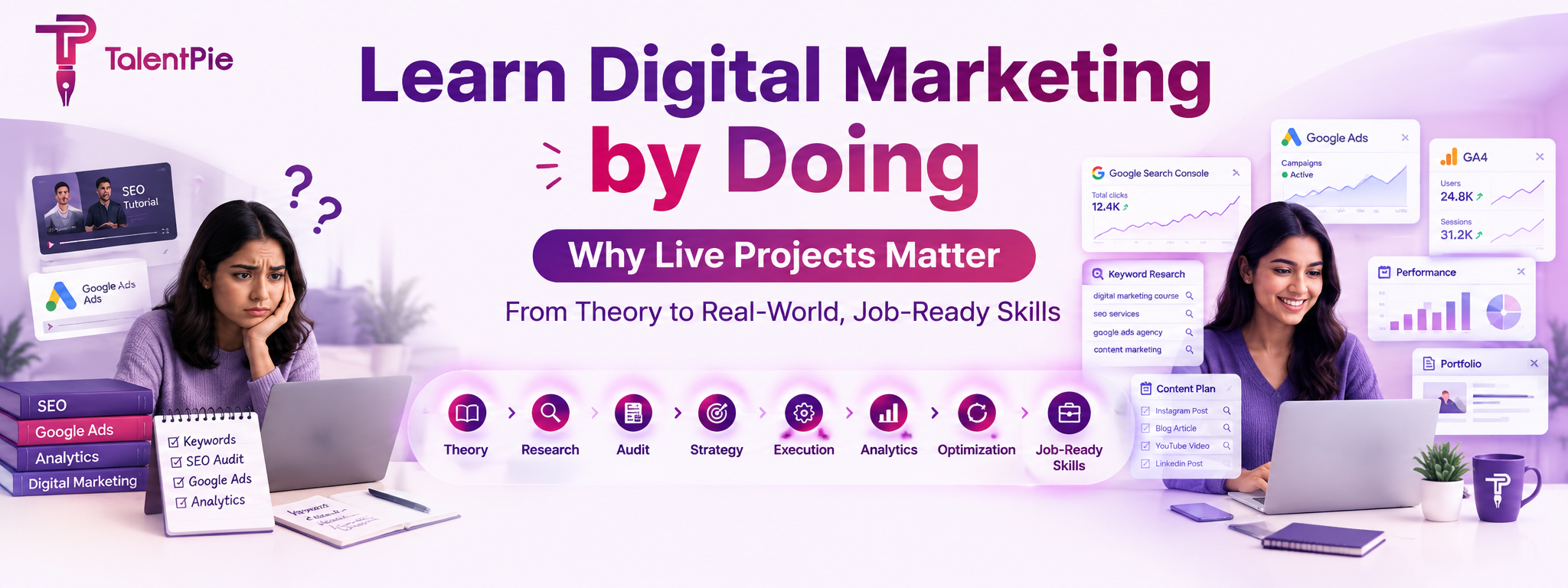
Together, these seven stages - Research, Audit, Strategy, Implementation, Monitoring, Reporting, Optimization - form the actual shape of agency-style work. A learner who has gone through this loop even once understands digital marketing in a way that no amount of passive watching can replicate.
Live Projects vs Theoretical Digital Marketing Training
|
Theoretical Learning |
Live Project Learning |
|
Learning concepts |
Applying concepts to a real situation |
|
Following tutorials step by step |
Making independent decisions |
|
Example-based practice |
Working within real workflows |
|
Limited room for mistakes |
Learning directly from mistakes |
|
Basic tool familiarity |
Practical, repeated tool usage |
|
Knowledge-focused |
Skill-focused |
|
No substantial deliverables |
Portfolio-oriented deliverables |
Both have a place - theory builds the vocabulary and foundation. But without live project training, that foundation rarely turns into a skill someone can put to work on day one of a job.
How Live Projects Help You Become Job-Ready
Build a Digital Marketing Portfolio
Audit reports, keyword sheets, campaign structures, and performance reports give a learner something concrete to show, rather than just a certificate.
Improve Your Resume
"Completed an SEO audit and improved on-page optimization for a live website" reads very differently from "learned SEO fundamentals."
Prepare for Interviews
Interviewers often ask how a candidate would approach a real scenario. Someone who has actually run through research, audit, and optimization stages has real examples to draw from, which can make interviews easier to navigate.
Understand Agency Workflows
Live projects, especially in an agency-style setting, expose learners to how marketing teams actually operate - deadlines, client expectations, and cross-functional coordination between SEO, content, and paid teams.
Develop Client Reporting Skills
Explaining a campaign's performance to a non-technical stakeholder is its own skill. Live projects give learners practice translating data into a report someone outside marketing can understand.
Gain Confidence With Digital Marketing Tools
Comfort with GA4, Search Console, and ad platforms comes from repeated real use, not memorized menus.
None of this guarantees a job. What it can do is give a learner tangible proof of ability and a stronger starting position when they do apply.
What Should a Good Digital Marketing Live Project Include?
A well-structured live project should generally cover:
- A clear business objective
- A defined target audience
- Competitor analysis
- Keyword research
- A website or content audit
- A documented marketing strategy
- Actual campaign execution
- Analytics setup
- Performance tracking over time
- A final report
- Optimization based on results
- Mentor or client feedback
- Final project documentation
One point worth being direct about: not every course that advertises "live projects" gives learners the same level of hands-on execution. Some let learners observe a mentor working on a real account. Others let learners run parts of the project themselves under supervision. Both get called "live," but the learning outcome is very different - which is exactly why it's worth asking specific questions before enrolling anywhere.
Digital Marketing Projects for Students and Freshers
For a student or fresher, the goal of practical training isn't to memorize more terms - it's to walk away with things they can point to. After solid hands-on training, a beginner should ideally be able to show:
- A completed SEO audit for a real or sample website
- A keyword research document with intent analysis
- A keyword-to-page mapping sheet
- A basic content strategy tied to that keyword research
- Evidence of on-page optimization work
- A social media content calendar
- A Google Ads campaign structure (even in a training environment)
- An analytics or reporting dashboard
- A written performance report
What matters isn't the number of projects listed on a certificate - it's whether each one reflects actual decisions the learner made, not just steps they copied.
How to Choose a Digital Marketing Course With Live Projects
Given how loosely the term "live project" gets used across the industry, it's worth asking a few pointed questions before choosing where to train.
Check Whether the Projects Are Actually Live
Ask directly: is this a real website or campaign, or a pre-built case study? Both have value, but they're not interchangeable.
Ask What You Will Personally Execute
Will you be researching, auditing, and implementing - or watching a mentor do it while you take notes? The answer changes what you'll actually be able to do afterward.
Check Mentor Feedback
Practical training without feedback tends to repeat the same mistakes. Ask how often learners get reviewed and by whom.
Look for Portfolio Deliverables
Will you walk away with documents - audits, keyword sheets, reports - you can actually show later?
Check the Tools Covered
Confirm the course uses real, industry-standard tools like GA4 and Google Search Console rather than only simplified, course-branded dashboards.
Understand the Course's Career Support
Ask specifically what "placement assistance" or "career support" includes - is it resume help, interview prep, referrals, or something else?
Look for an Agency-Backed Learning Environment
Training connected to an actual agency tends to expose learners to real client workflows, deadlines, and reporting standards - a different experience from a purely classroom-based course.
Why Learn Digital Marketing Through Live Projects at TalentPie?
TalentPie Institute is the training division of Gary Global Solutions, and its digital marketing course is built around the ideas covered throughout this article: research, execution, feedback, and measurable output, not just recorded lectures.
The program is a 3-month offline digital marketing course delivered at Nx One, Greater Noida West, covering SEO, AEO & GEO, social media marketing and management, and performance marketing. Learners get exposure to live client and agency project work as part of the training, guided by mentor-led practical sessions, with an emphasis on portfolio-oriented output - the kind of documented, decision-driven work discussed in the sections above. The course also includes placement assistance for learners preparing to enter the job market.
If you're evaluating your Digital Marketing Course options, it's worth checking how much of the training is genuinely hands-on versus lecture-based - a question this article has already walked you through.
Final Thoughts: Learn Digital Marketing by Doing
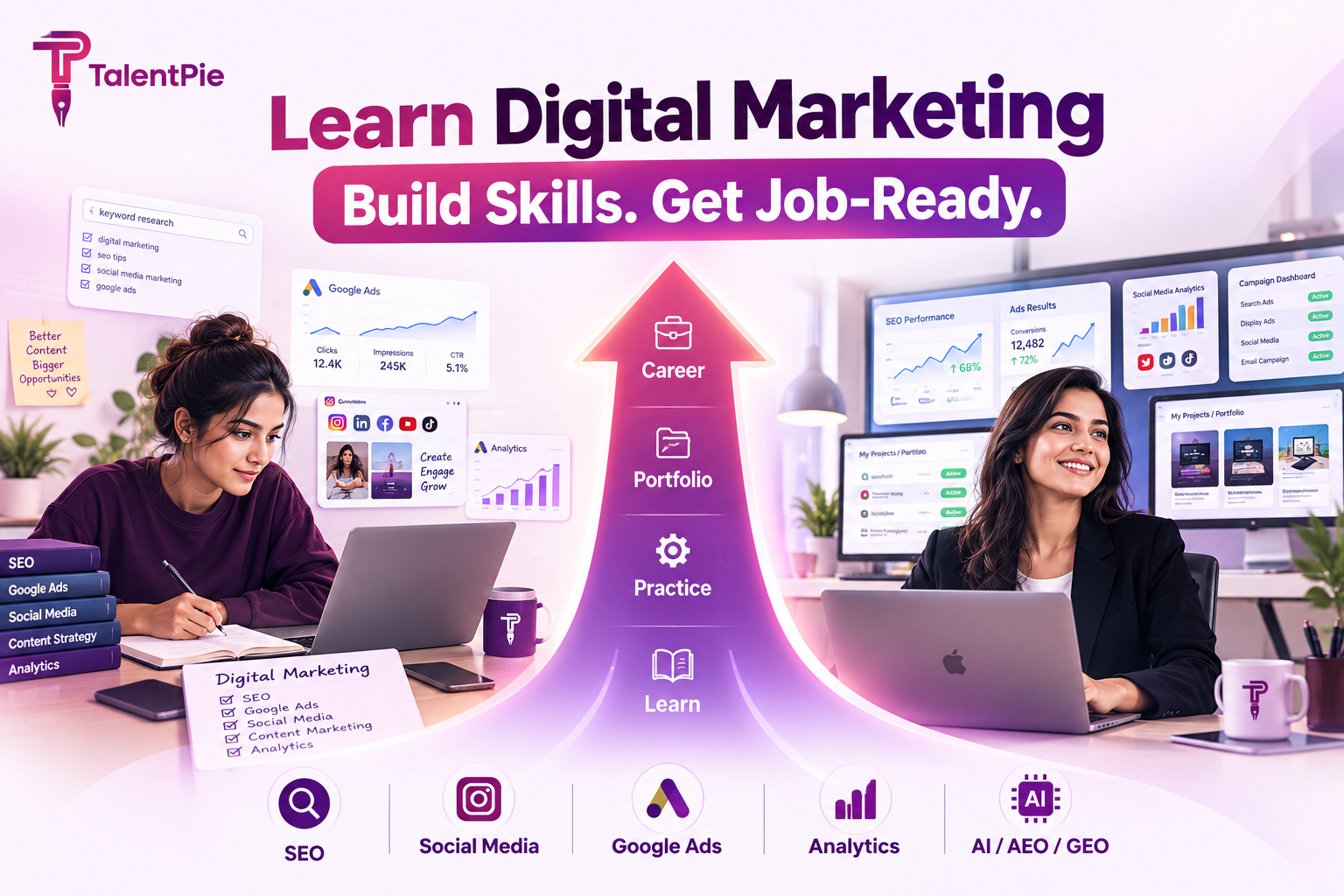
The path that actually works tends to look like this: knowledge first, then practice, then real execution, then feedback on what you got wrong, then optimization, then a portfolio that proves it, and finally the confidence to walk into a job and talk about work you've actually done.
Skipping straight from tutorials to job applications leaves a gap that interviewers tend to notice quickly. If you're serious about a career in this field, the more useful question isn't "which platform should I watch videos on" - it's "where can I actually do the work, make the decisions, and get told when I'm wrong." That's what turns a learner who knows digital marketing into one who can practice it.
FAQs
1.What are digital marketing live projects?
They're hands-on assignments where a learner works on a real or realistically structured website, brand, or campaign - doing the research, execution, and analysis themselves rather than just watching a demonstration.
2.Why are live projects important in digital marketing?
They turn theoretical knowledge into applied skill. A learner who has audited a real site or run a real campaign understands the decisions involved in a way that reading or watching alone can't teach.
3.Can beginners learn digital marketing through live projects?
Yes. Beginners typically start with guided, mentor-supported tasks - like a basic audit or keyword research exercise - and build up to more independent execution as their confidence grows.
4.What projects can I do while learning digital marketing?
Common examples include an SEO audit, keyword research and mapping, a content strategy, a social media calendar, a Google Ads campaign structure, and a performance report built from real analytics data.
5.Do live projects help build a digital marketing portfolio?
Yes. Deliverables like audit reports, keyword sheets, and campaign documentation give learners tangible proof of ability, which is far more persuasive in interviews than a certificate alone.
6.What skills can I learn through a digital marketing live project?
Skills typically include keyword research, on-page and technical SEO, content planning, social media execution, paid campaign setup, conversion tracking, and analytics-based reporting.
7.What is the difference between a live project and a dummy project?
A dummy or simulated project uses fictional data in a controlled scenario. A live project involves a real website, business, or campaign, with real data and real consequences to the decisions made.
8.How do live projects help with digital marketing jobs?
They give candidates concrete examples to discuss in interviews and documented work samples for a portfolio - both of which can make a candidate's practical ability easier to demonstrate than course completion alone.
9.What should I look for in a digital marketing course with live projects?
Check whether the projects are genuinely live, how much you'll personally execute versus observe, whether mentor feedback is included, what deliverables you'll walk away with, and what tools the course actually uses.
10.Does TalentPie provide live digital marketing projects?
Yes. TalentPie's digital marketing course includes live client and agency project exposure alongside mentor-led practical training, delivered as part of its 3-month offline program in Greater Noida West.