Most people who finish a digital marketing course can define SEO, explain what a Google Ads campaign is, and recite the difference between reach and engagement. Fewer of them can sit in front of an actual client website, look at a drop in organic traffic, and work out what is really going wrong.
That gap between knowing the theory and being able to execute it is the main reason so many beginners struggle after completing a course. They have studied the subject. They have not practised the job.
A digital marketing course with live projects closes that gap. You don't just study concepts; you apply them to real websites, real content calendars and real ad accounts, and then someone experienced tells you what you got wrong and why. At TalentPie, that is the core of how the programme is built: actual work, done under guidance, that you can later explain in an interview with confidence.
Why Learning Digital Marketing Through Live Projects Matters
Digital marketing is an execution-driven field. You can know every SEO ranking factor and still not know what to prioritise on a website that is losing traffic. You can understand how Google Ads auctions work and still struggle the first time you have to structure a campaign, choose match types and decide where the budget should go.
A few contrasts come up constantly in real work:
- Knowing what keyword research is isn't the same as building a keyword strategy for a website that already has content, rankings and real competitors.
- Knowing what an SEO audit involves isn't the same as running one: finding indexing issues, spotting thin content and deciding what to fix first when you can't fix everything at once.
- Knowing how Google Ads works isn't the same as setting up a campaign, watching the data for two weeks and deciding whether to pause an ad group or shift budget.
- Knowing what a content calendar is isn't the same as planning one for a business with a specific audience, tone and product.
When you make a mistake on a live project, such as targeting the wrong search intent or writing ad copy that gets clicks but no conversions, you remember why it was wrong far longer than you would remember a slide that said "match search intent carefully".
Live projects also teach systems thinking. SEO, paid ads, content and social media don't operate in isolation. A landing page built for a Google Ads campaign still needs decent on-page SEO, and a drop in ad performance sometimes traces back to a technical website issue rather than the campaign. You only notice these connections when you work across channels on the same project.
Why Certificates Alone Don't Get You Hired
Knowledge answers "what is this?" Skill answers "what do I do with this, right now, for this business?" A learner can watch twenty hours of video on keyword research and still freeze when handed a real spreadsheet of search terms and asked which ones are worth targeting.
Recruiters have noticed this gap. A resume full of certificate logos is now treated as a starting point rather than a deciding factor. What moves a candidate forward is evidence: a project, a decision they made and can explain, a mistake they caught and fixed.
Where the Skill Gap Usually Shows Up
- SEO: defining "search intent" in an interview, but never having grouped a real keyword list by what the searcher wanted.
- Google Ads: knowing Quality Score exists, but not knowing that a low score often comes from a mismatch between ad copy and landing page, or how to fix it.
- Social media: knowing Reels get more reach than static posts, but never having planned a month of content for a real brand.
- Analytics: reciting that GA4 tracks engagement rate, but not being able to open a real property and explain why traffic spiked last week.
- AI tools: getting a blog outline from ChatGPT, but not knowing whether it matches what the audience actually searches for, or how to fact-check and edit it.
Live Projects vs Theory-Only Digital Marketing Training
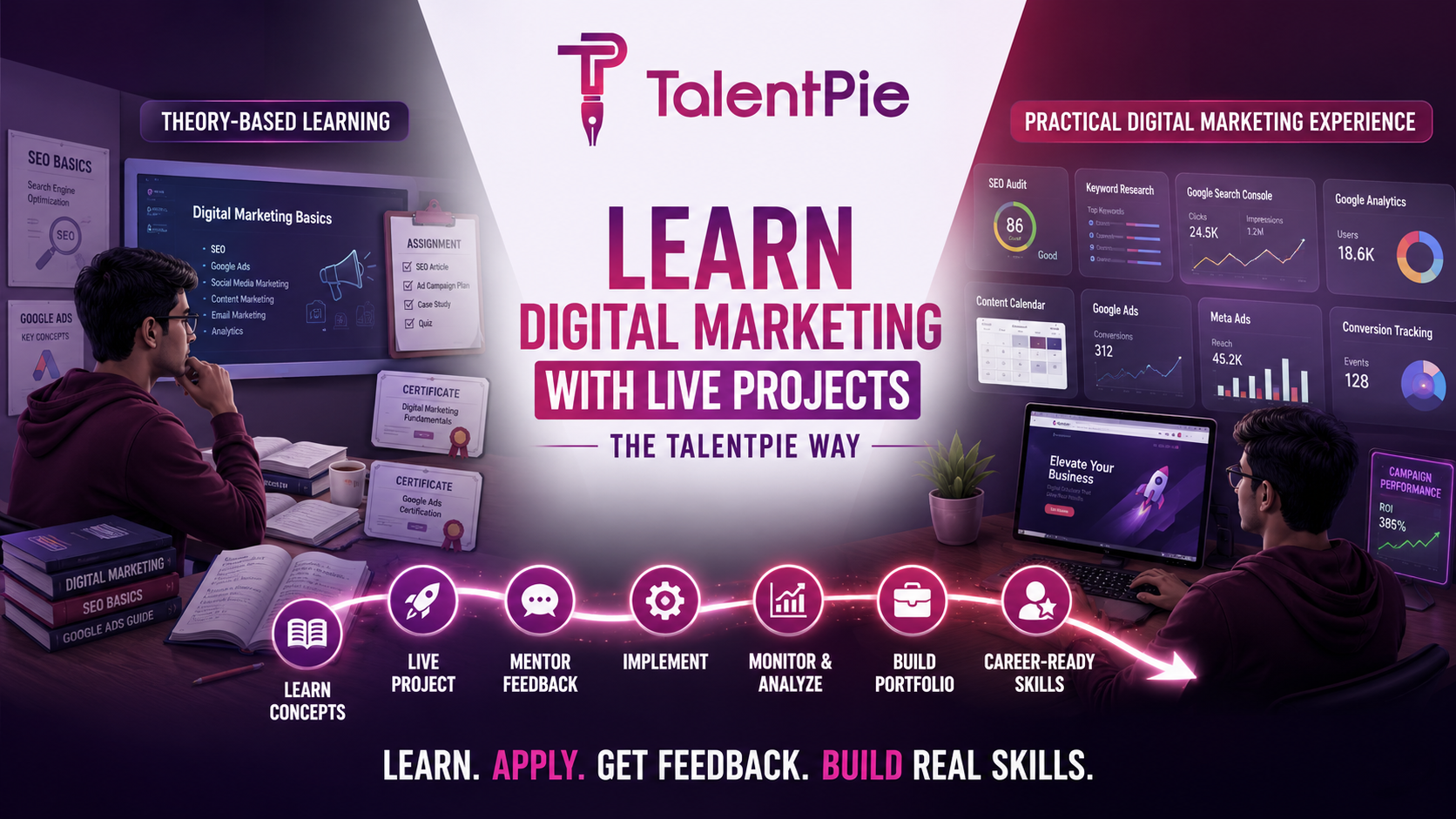
Theory-Only Learning | Live Project Learning |
Learning concepts | Applying concepts to a real situation |
Following tutorials step by step | Making independent decisions |
Example-based practice | Working within real workflows and deadlines |
Limited room for mistakes | Learning directly from mistakes, with feedback |
Basic tool familiarity | Repeated, practical tool usage (GA4, Search Console, ad platforms) |
Knowledge-focused | Skill-focused |
No substantial deliverables | Portfolio-ready deliverables |
Both have a place. Theory builds the vocabulary and foundation, but without live project work that foundation rarely turns into a skill you can use on day one of a job.
What Makes TalentPie Different?
TalentPie doesn't compete on who lists the most modules or certificates. That comparison tells you little about whether you will be able to do the job afterwards. The real differentiator is simpler: real work, not dummy assignments.
Learn in an Agency-Backed Environment
Training runs alongside a working digital marketing agency, so you see how a project brief turns into a plan, how priorities shift when something doesn't work, and how professionals report progress to a client without over-promising. These are habits, and habits are learned by doing the work repeatedly.
Work on Live Client Projects
In practice, "live project" means real, ongoing work: auditing an actual website, researching keywords for a real business, drafting content for a live blog, or building a campaign structure that a mentor reviews before anything goes further. A textbook exercise has one answer the instructor already knows. A live project has constraints (an existing website, real competitors, a specific audience) that force you to think.
Get Mentor Feedback Every Week
Self-review only goes so far. Mentor feedback points out the keyword opportunity you overlooked, the technical issue you didn't check, or the ad creative that follows best practice on paper but wouldn't convert. Without it, you can repeat the same mistakes without realising.
Build Portfolio-Ready Work
"I completed a digital marketing course" is a sentence plenty of candidates can say. Showing an interviewer an SEO audit you performed, a keyword strategy you built or a campaign structure you designed shows you can do the job, not just describe it.
What You Learn Through Live Digital Marketing Projects
SEO on Real Websites
A real SEO workflow on a live project usually includes:
- Researching keywords and mapping them to search intent, not just search volume
- Studying what competitors rank for and where the gaps are
- Running an SEO audit to find indexing problems, missing metadata, duplicate content and thin pages
- Applying on-page SEO: titles, headings, internal linking and content structure
- Checking technical fundamentals such as site speed, mobile usability and crawlability
- Using Google Search Console to read impressions, clicks and query-level data
- Using Google Analytics to understand what users do once they land
- Writing a short report on what was found and what was done about it
See the full SEO course in Noida syllabus.
AEO and GEO for AI Search
More queries are now answered directly by AI-powered search and generative engines such as Google AI Overviews, ChatGPT and Perplexity. Answer Engine Optimization (AEO) and Generative Engine Optimization (GEO) are about structuring content and brand signals so these systems can understand and cite you. Traditional SEO isn't disappearing; the skill set is expanding. Nobody can promise specific placements in AI answers, but you can learn how search is changing and write accordingly. Learn more about our AEO and GEO training.
Social Media Marketing
On a live project, social media marketing means understanding the audience well enough to know what they respond to, planning a calendar that balances promotional and non-promotional posts, creating content that fits the brand's voice, and reviewing engagement data to see what's working. Explore the social media marketing course.
Google Ads and Meta Ads
Paid marketing is where theory and execution diverge most, because the platforms are complex and a real budget is at stake. Live ad work covers campaign structure, audience targeting, ad creatives, landing pages built to convert, conversion tracking and budget management. Reading cost per click, click-through rate and conversion rate, then deciding what to change, is the most important part. No course can promise guaranteed leads or a specific return on ad spend; practical training teaches you to read the data correctly and optimise with intent. See the performance marketing course.
How the TalentPie Live Project Journey Works
Step 1: Audit and Strategy
Every project starts by understanding what already exists: the website or account, existing content, current rankings, audience search intent, competitors and technical issues such as broken links, slow pages or weak internal linking. You can't fix what you haven't diagnosed.
Step 2: Implementation
Strategy turns into visible output: optimising content, fixing on-page and technical issues, publishing social content to the calendar, or building an ad campaign around the agreed targeting and budget. This is usually where learners discover that strategy documents rarely translate perfectly into execution.
Step 3: Monitoring and Reporting
Work doesn't end when something goes live. You track traffic, ranking movement, engagement, conversions and campaign performance, then explain what the numbers mean and what action they suggest. Reporting is the most underrated part of the job and the part theory-only courses usually skip.
How to Get the Most Out of a Live Project
- Start with the business goal. Work through business goal → audience → funnel → marketing objective → SEO, ads or content strategy → KPI. Skipping straight to keywords or ad creation produces work that is technically sound but strategically misaligned.
- Record your starting point. Note baseline traffic, rankings, leads, conversions and known technical issues before you change anything. Without a baseline you can't show what changed.
- Prioritise. A short list of high-impact actions, sequenced sensibly, beats a scattered attempt to fix everything at once.
- Keep a change log. If three things changed in the same week and traffic moved, you won't know which one mattered without a record.
- Document what didn't work. A failed test, with your reasoning, shows marketing thinking that successes alone can't.
- Turn it into a case study. Problem, research, strategy, execution, optimisation, results, learnings.
Common Challenges in Live Projects and How to Handle Them
- Fear of making mistakes: test changes on a small scale first, work under mentor supervision, and document decisions so mistakes become learning material.
- Unexpected performance drops: a sudden fall in traffic or a spike in cost per acquisition calls for diagnosis before action. Random changes make problems harder to untangle.
- Unclear client requirements: ask clarifying questions, propose a prioritised plan and manage expectations honestly.
- Limited data: newer businesses and small budgets produce thin data. Work with it, but be clear about the limits of any conclusion.
- Tight deadlines and many channels: focus first on what will move the needle, and use one KPI framework so SEO, paid, content and social pull towards the same outcome.
What Your Digital Marketing Portfolio Should Show
For a student or fresher, the goal is to walk away with work you can point to. After solid hands-on training, you should be able to show:
- A completed SEO audit for a real or sample website
- A keyword research document with intent analysis, and a keyword-to-page mapping sheet
- A content strategy tied to that keyword research, with examples of on-page optimisation
- A social media content calendar with sample creatives and engagement trends
- A Google Ads or Meta Ads campaign structure: objective, audience, budget split, ad variations tested, and CTR, CPC and conversion trends
- An analytics dashboard with the KPIs you tracked, the insights you drew and the recommendations you made
- A written performance report
What matters is not the number of projects but whether each one reflects decisions you made. Be mindful of confidentiality: client names, revenue figures and proprietary details shouldn't be shared publicly without permission, even when the approach is worth showcasing.
Skills You Build and What Recruiters See
- Technical skills: confident, repeated use of Google Search Console, Google Analytics, keyword research tools and ad dashboards.
- Analytical skills: looking at a traffic dip or stalled conversion rate, forming a reasonable hypothesis about why, and testing it. Real data has no answer key.
- Creative skills: writing ad copy that is accurate and persuasive, and planning content that fits a brand's voice without feeling repetitive.
For roles such as SEO Executive, Digital Marketing Executive, Social Media Executive, PPC Executive, Performance Marketing Associate or Content Marketing Executive, interviewers ask how you would handle a real situation: "How would you investigate a sudden drop in rankings?" or "How would you structure a campaign on a limited budget?" Live project work gives you a specific answer that holds up under follow-up questions. It doesn't guarantee a job, and any claim that it does should be treated with scepticism. For pay expectations, see our guide to digital marketing salary in India.
Who Should Learn Digital Marketing With Live Projects?
- Students and freshers who understand the concepts but have nothing to show for it yet.
- Working professionals who want to formalise skills picked up informally, especially technical SEO, paid campaigns and structured reporting.
- Career switchers competing against candidates with more direct experience, for whom a portfolio of real work speaks louder than a career-change story.
- Aspiring freelancers who need a repeatable process (audit, implementation, monitoring, reporting) before running paid client work alone.
New to the field? Start with our roadmap on how to become a digital marketer.
How to Choose a Digital Marketing Course With Live Projects
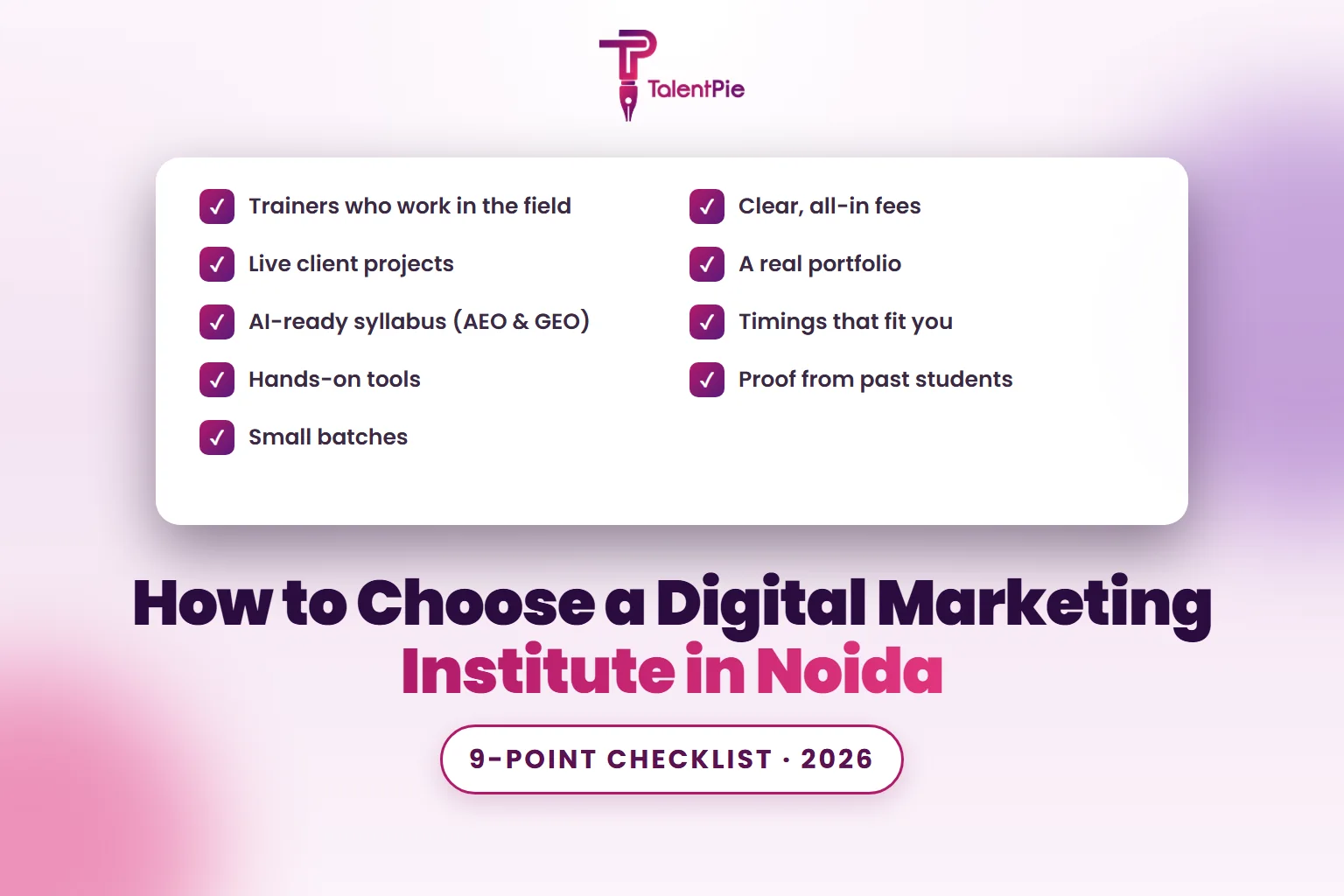
"Live project" is used loosely across the industry. Some courses let learners watch a mentor work on a real account; others let learners run parts of the project themselves under supervision. Both get called "live", but the outcomes are very different. Ask these questions before enrolling anywhere:
- Are the projects actually live? A real website or campaign, or a pre-built case study?
- What will I personally execute? Researching, auditing and implementing, or taking notes while someone else does it?
- How often is my work reviewed, and by whom?
- What deliverables will I leave with? Audits, keyword sheets and reports you can show later?
- Which tools will I use? Industry-standard tools like GA4 and Google Search Console, or simplified course dashboards?
- Is AI search covered? Does the syllabus include AEO and GEO, not just traditional SEO?
- What does "placement assistance" include? Resume help, mock interviews, referrals, or something else?
- Is the training connected to a working agency? Agency-backed training exposes you to real deadlines, workflows and reporting standards.
TalentPie's Live Project Programme at a Glance
Duration | 3 months |
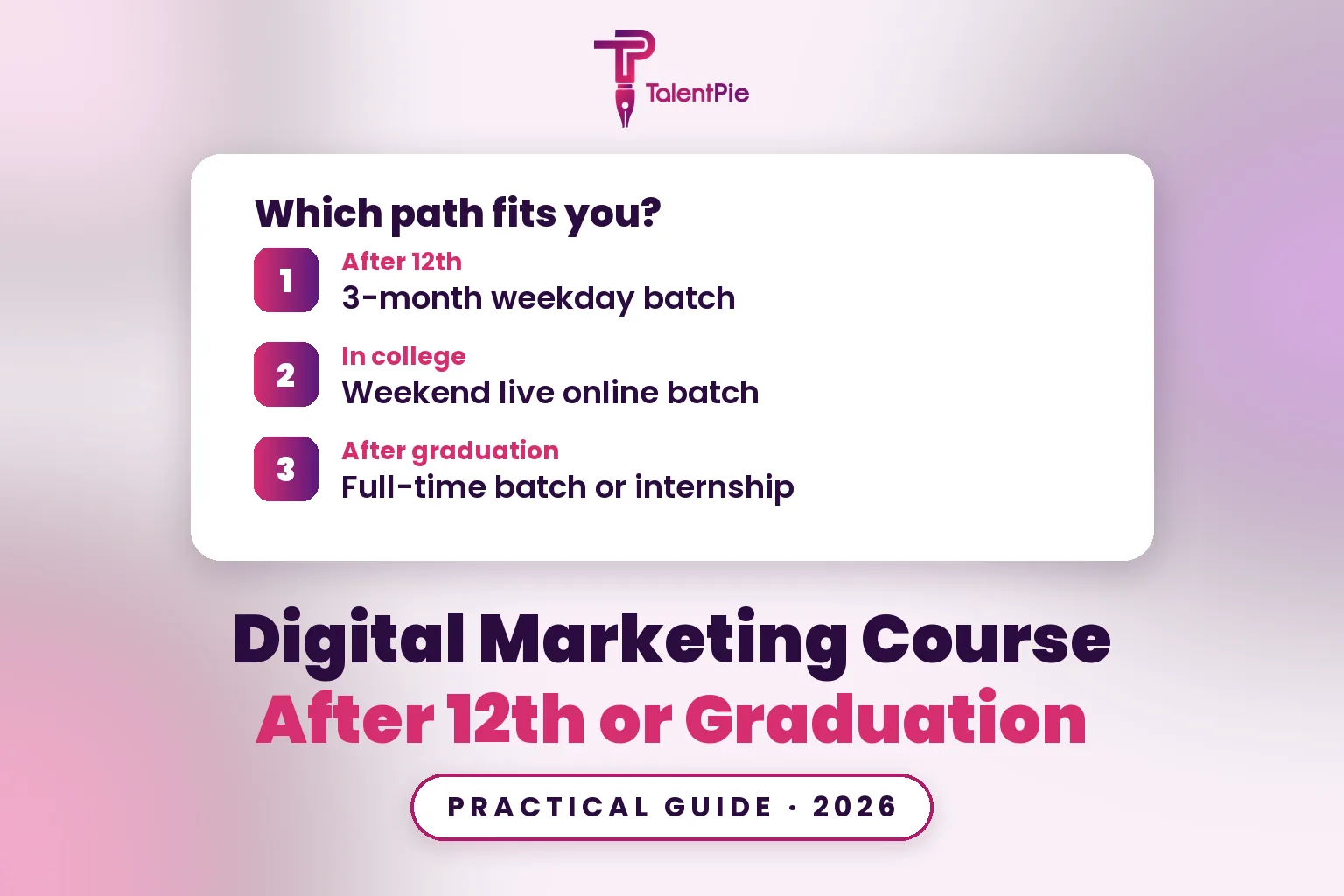
Offline batch | Monday to Friday, 3 hours a day, at Nx One, Tech Zone IV, Greater Noida West |
Online batch | Live weekend classes, Saturday and Sunday, 2 hours a day, with the same syllabus, mentors and live projects |
Covers | SEO, AEO and GEO, social media marketing, Google Ads, Meta Ads, analytics and reporting |
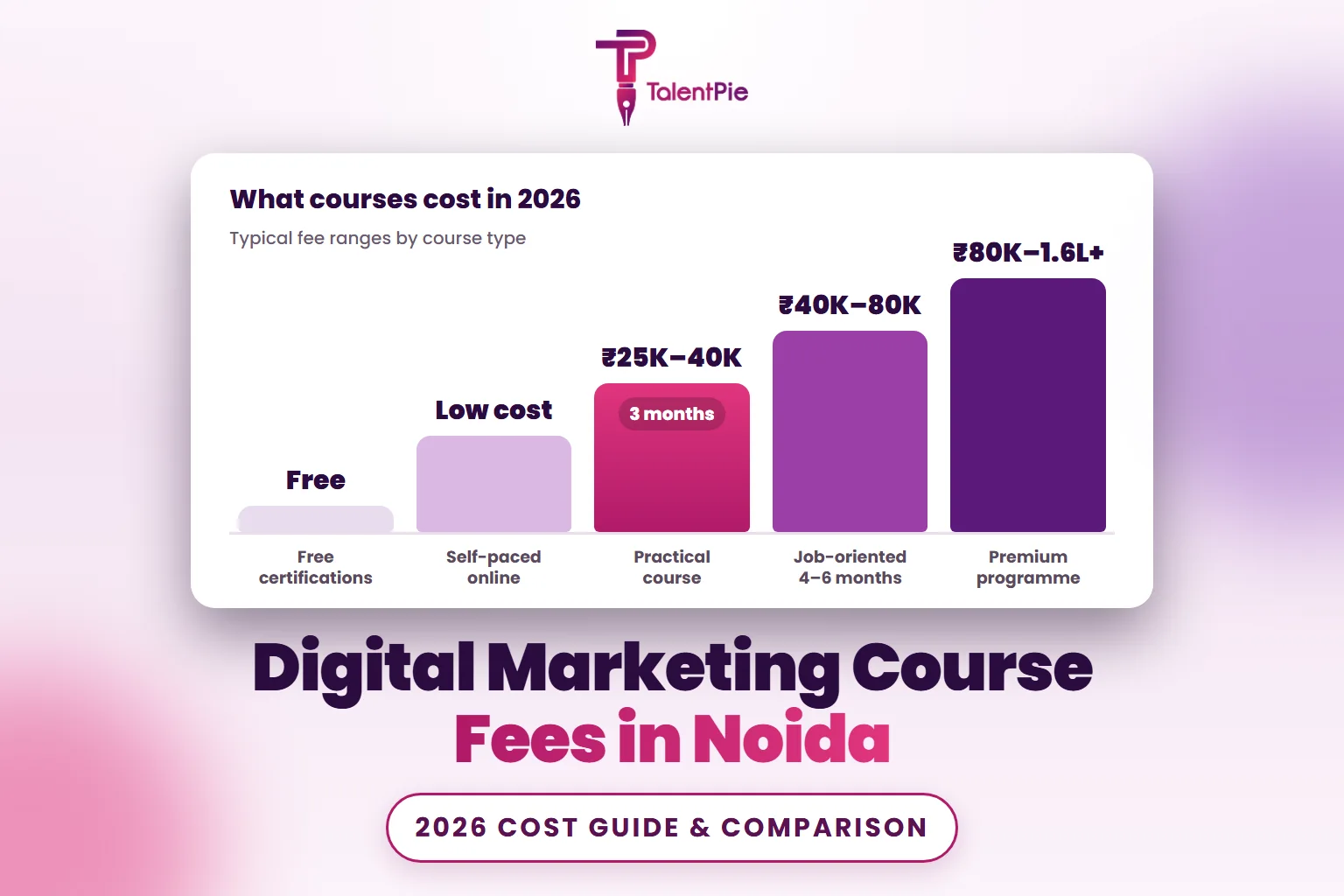
Fee | ₹25,000 for the complete programme, the same for both batches (see fee details) |
Career support | Portfolio review, mock interviews and opportunity support. This is placement assistance, not a job guarantee (how placement support works) |
If you want a job-oriented digital marketing course that treats practical execution as the core of learning rather than an add-on, explore the offline course in Greater Noida West or the weekend online batch.
Frequently Asked Questions
What is a digital marketing course with live projects?
It is a training format where, instead of only studying concepts, you work on real marketing tasks such as auditing websites, planning content calendars and building ad campaigns, under a mentor who reviews and corrects your work.
Is live project experience really important, or just a marketing term?
It matters because digital marketing is a doing-based skill. Understanding a concept and applying it to a real website or account with real constraints are different abilities, and live projects build the second one.
Are certificates useless without live project experience?
No, but on their own they rarely decide a hiring outcome. Recruiters look for evidence you can do the work, such as an audit, a campaign structure or a report you can explain.
What should a good live project include?
A clear business objective, a defined audience, competitor and keyword research, an audit, a documented strategy, real execution, analytics setup, performance tracking, optimisation based on results, mentor feedback and a final report.
What will I learn at TalentPie?
SEO (audits, keyword research and technical fundamentals), AEO and GEO for AI-driven search, social media marketing, and paid advertising through Google Ads and Meta Ads, all applied through live client projects.
Is TalentPie suitable for beginners?
Yes. No prior experience is needed. The programme suits beginners, freshers, working professionals, career switchers and aspiring freelancers.
Can I do the live project course online?
Yes. The weekend online batch runs live on Saturdays and Sundays with the same syllabus, mentors and live client projects as the offline batch, at the same fee.
Does TalentPie provide placement assistance?
Yes. TalentPie offers portfolio review, mock interviews and opportunity support. This is assistance, not a guaranteed job or salary.
Where is TalentPie located?
The offline classroom is at Nx One, Tech Zone IV, Greater Noida West, Uttar Pradesh, convenient for learners across Noida, Noida Extension and Greater Noida.
How long is the course, and what does it cost?
Three months. The fee is ₹25,000 for the complete programme, the same for the weekday offline and weekend online batches.
Final Thoughts
Learning digital marketing and being able to practise it professionally are two different stages, and most theory-only courses stop at the first. The pattern that builds usable skill is simple to describe: learn the concept, apply it to a real project, get feedback on what you missed, read what the results show, and adjust. Repeated across SEO, social media and paid advertising, that cycle builds the kind of judgment a resume or certificate alone can't show.
If that is the practical, project-based learning you have been looking for, book a free counselling call to see how TalentPie's live project structure works before you decide.