Search has changed more in the last two years than in the ten before it. People still type questions into Google. But now they also ask ChatGPT, read Google's AI Overviews, and talk to voice assistants. Each of these gives answers in a different way.
That is why three terms keep coming up in marketing jobs and courses: SEO, AEO and GEO. Are you a student, a fresher or a working professional? Then you need to know what each one means. You also need to know which skills to learn first.
This guide explains SEO vs AEO vs GEO in simple words. It has real numbers, examples and a clear learning plan. It is written by Prateek Gupta, educator and founder of TalentPie, who teaches the course himself, together with the TalentPie mentors. We do SEO, AEO and GEO work every week on live client websites at our partner agency, Gary Global Solutions, in Greater Noida West.
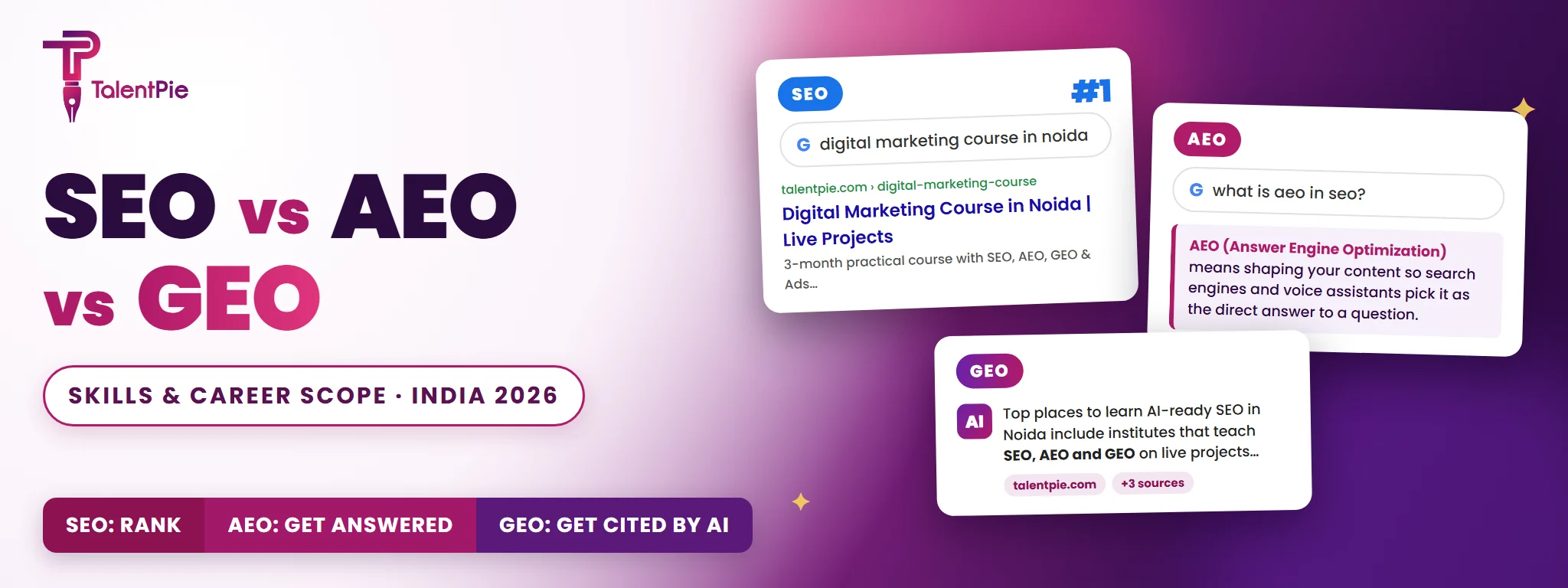
Quick answer: SEO (Search Engine Optimization) helps your page rank in Google's list of results. AEO (Answer Engine Optimization) helps your content become the direct answer in featured snippets, AI Overviews and voice search. GEO (Generative Engine Optimization) helps AI tools like ChatGPT, Gemini and Perplexity mention and cite your brand. You need all three in 2026.
Watch: SEO vs AEO vs GEO Explained in About a Minute
Short on time? In this quick video (in Hindi), TalentPie founder Prateek Gupta shows how search has moved from ten blue links (SEO), to AI summaries at the top of Google (AEO), to answers inside generative AI tools like ChatGPT, Perplexity and Gemini (GEO).
Video: "SEO vs AEO vs GEO | Emerging trends with AI Powered Search" by Prateek Gupta. Watch on YouTube.
Now let us go deeper into each one, with examples and numbers.
SEO vs AEO vs GEO: The Short Answer
Think of it like this. SEO gets you on the list. AEO gets you picked as the answer. GEO gets you named by the AI.
| Point | SEO | AEO | GEO |
|---|---|---|---|
| Full form | Search Engine Optimization | Answer Engine Optimization | Generative Engine Optimization |
| Main goal | Rank high in search results | Be the direct answer | Be mentioned or cited in AI answers |
| Where you show up | Google and Bing results pages | Featured snippets, "People also ask", AI Overviews, voice assistants | ChatGPT, Gemini, Perplexity, Copilot, Google AI Mode |
| What success looks like | Rankings, clicks, traffic | Snippet wins, answer box visibility | Brand mentions and citations in AI answers |
| Main work | Keywords, content, technical fixes, links | Question-based content, clear short answers, structure | Brand facts, trusted mentions across the web, original data |
| Example query | "seo course in noida" | "what is aeo in seo" | "best place to learn AI-ready SEO in Noida" |
What Is SEO (Search Engine Optimization)?
SEO is the process of improving a website so it ranks higher in search engines like Google for the words people search. Higher rankings bring more visitors without paying for ads.
SEO is the base of everything else in this guide. If Google cannot find, read and trust your page, it will not show it in normal results, in snippets or in AI Overviews.
The three main parts of SEO
- On-page SEO: choosing the right keywords, writing helpful content, and using good titles, headings and internal links.
- Technical SEO: making sure the site loads fast, works on mobile, and can be crawled and indexed. This includes sitemaps, redirects and canonical tags.
- Off-page SEO: earning links and mentions from other trusted websites.
SEO example
A student in Noida searches "seo course in noida". Google shows ten blue links. The institute with the clearest course page, a fast website and good reviews is more likely to rank near the top and get the click. That is SEO at work. You can see how we teach it in our SEO course in Noida.
What Is AEO (Answer Engine Optimization)?
AEO means writing and structuring your content so search engines and assistants pick it as the direct answer to a question. Instead of just ranking, you aim to be the answer people read first.
Answers now appear in many places: featured snippets at the top of Google, the "People also ask" box, Google's AI Overviews, and voice assistants like Alexa and Google Assistant. When someone asks "what is AEO in SEO?", the engine wants one clear answer, not ten links.
How to write answer-ready content
- Start with the real question. Use the exact words people search, like "How long does it take to learn SEO?"
- Answer in the first 40 to 60 words. Give the direct answer right under the heading, then explain.
- Use clear structure. Short paragraphs, numbered steps, bullet lists and tables are easy for engines to read.
- Add an FAQ section. Cover the follow-up questions people usually ask next.
- Keep facts accurate and current. Old prices or dates make engines, and readers, trust you less.
AEO example
Look at the "Quick answer" box at the top of this article. It defines all three terms in under 60 words, right below the introduction. That is the kind of block Google often pulls into a featured snippet or AI Overview.
What Is GEO (Generative Engine Optimization)?
GEO is the practice of helping AI tools like ChatGPT, Gemini, Perplexity and Google AI Mode understand, trust and mention your brand in the answers they write.
Generative AI does not show a list of links. It writes a fresh answer and sometimes names a few sources. If your brand is not among those sources, the user may never hear of you.
How AI tools decide who to mention
No AI company shares its full formula. But from our client work and public research, AI answers tend to favour brands that:
- have clear, consistent facts (name, location, prices, services) across their own website and other sites;
- are mentioned by trusted sources, such as news sites, industry directories, review platforms and community forums;
- publish original information, such as their own data, case studies and expert opinions, that others cannot copy;
- have pages that are easy to read and quote, with short answers and clear headings.
GEO example
Ask an AI assistant, "Where can I learn digital marketing with live projects in Greater Noida West?" It will build its answer from sources it trusts. Now picture two institutes. The first shows the same address, fee and course details on its website, Google Business Profile and education directories. The second has mixed or missing details. The first one has a much better chance of being named.
We see this change on our own website. Visitors now arrive at talentpie.com from AI assistants, not just from Google. That is GEO showing up in real data.
Why SEO, AEO and GEO Matter in 2026: The Numbers
These are not future trends. They are already here:
- 2.5 billion people use Google's AI Overviews every month. Google CEO Sundar Pichai shared this at Google I/O in May 2026 (CNBC).
- AI Overviews can cut clicks sharply. An Ahrefs study of 300,000 keywords found that when an AI Overview appears, the top-ranking page gets a 58% lower click-through rate on average, up from 34.5% in their earlier study (Ahrefs, February 2026).
- ChatGPT has over 900 million weekly users worldwide, and India has about 100 million weekly users, making it ChatGPT's second-largest market (TechCrunch).
- Experts expected a big shift. In 2024, Gartner predicted that traditional search volume would fall 25% by 2026 as people moved to AI chatbots (Gartner). Google search has not collapsed. But search has clearly spread across more places.
What this means for you: ranking #1 is still valuable. But it no longer promises clicks. Employers now want marketers who can do three things. They can rank a page (SEO). They can win the answer box (AEO). And they can get the brand named by AI (GEO). That person is worth much more than someone who only knows keywords.
Is SEO Dead Because of AI? No. Here Is How the Three Fit Together
SEO is not dead. It is the foundation that AEO and GEO are built on.
Google says this clearly. Its official guidance states that "there are no additional requirements to appear in AI Overviews or AI Mode, nor other special optimizations necessary" and that pages need to be "indexed and eligible to be shown in Google Search with a snippet" (Google Search Central). In other words, good SEO is the entry ticket.
Think of the three as floors of one building:
- Ground floor: SEO. Your site is crawlable, fast, helpful and trusted.
- First floor: AEO. Your content answers questions clearly enough to be quoted.
- Top floor: GEO. Your brand is known and trusted across the web, so AI tools name you.
You cannot build the top floor without the ground floor. That is why a good course teaches all three together.
SEO vs AEO vs GEO: Skills, Tools and Results Compared
| Point | SEO | AEO | GEO |
|---|---|---|---|
| Key skills | Keyword research, on-page SEO, technical audits, link building | Question research, concise writing, content structure, FAQ writing | Brand and entity building, digital PR, original research, reputation work |
| Common tools | Google Search Console, GA4, Screaming Frog, Ahrefs or Semrush | "People also ask" research, AnswerThePublic, Search Console query data | Manual AI prompt checks, AI visibility trackers, brand mention monitoring |
| Time to see results | Usually 3 to 6 months | Weeks to a few months, once pages rank | Months, because trust builds slowly |
| How to measure | Rankings, clicks, organic traffic, leads | Snippets won, "People also ask" presence, AI Overview mentions | How often AI tools name or cite you; traffic from AI assistants in GA4 |
| Best for | Every website | Sites answering "what", "how" and "why" questions | Brands that want to be recommended, not just found |
A Real Example: One Page Done Three Ways
Here is how we would handle one page, an institute's course fee page, with each approach.
1. The SEO way
Target the keyword "digital marketing course fees in noida". Put it in the page title, the main heading and the URL. Make the page load fast on mobile. Link to it from the course pages.
2. The AEO way
Add a clear question-and-answer block near the top: "How much does the digital marketing course cost? The full 3-month course costs ₹25,000, and the fee is the same for the offline and online batches." Add an FAQ section for questions like "Can I pay in instalments?" This is how our own course fees page is written.
3. The GEO way
Make sure the same fee, duration and address appear everywhere: the website, Google Business Profile, education directories and social profiles. You can also publish an llms.txt file. This is a plain-text summary of your site that some AI tools read. Keep it matched to the live website. Then earn mentions in local news or student groups. When AI tools find the same facts in many trusted places, they feel safer naming you.
Career Scope of SEO, AEO and GEO in India
Indian companies still hire mostly for "SEO" job titles. But more job posts now ask for skills in AI search, AI Overviews and answer-ready content. Marketers who can show all three stand out.
Job roles you can target
- SEO Executive or SEO Analyst
- Content and AEO Writer
- Technical SEO Specialist
- AI Search (AEO/GEO) Specialist
- Digital Marketing Executive
- Freelance SEO consultant for local businesses
What can you earn?
Pay depends on your city, skills and portfolio. As a rough guide, freshers in SEO roles in India usually start at a few lakh rupees a year. One 2026 industry estimate puts entry-level AEO and GEO specialists at ₹6 to 10 LPA, and senior specialists at ₹10 to 18 LPA (Networkers Home). Treat these as estimates, not promises. For a detailed breakdown, read our guide to digital marketing salary in India.
The biggest factor is proof. A portfolio with a real SEO audit, a page that won a featured snippet, or a brand you helped get named in AI answers speaks louder than any certificate.
How to Learn SEO, AEO and GEO: A 90-Day Roadmap
If you are starting from zero, follow this order. Each step builds on the one before.
Days 1–30: Build your SEO base
- Learn how search engines crawl, index and rank pages.
- Practise keyword research and search intent.
- Set up and read Google Search Console and GA4.
- Run your first SEO audit on a real website.
Days 31–60: Add AEO
- Find the questions your audience asks using "People also ask" and Search Console data.
- Rewrite pages with short, direct answers under each heading.
- Add FAQ sections and clear tables.
- Track which pages win featured snippets or appear in AI Overviews.
Days 61–90: Add GEO
- Check how ChatGPT, Gemini and Perplexity describe a brand today.
- Fix wrong or missing brand facts across the website and profiles.
- Plan mentions on trusted sites, such as directories, news and communities.
- Set up a GA4 report for traffic from AI assistants.
Doing this on a real website with mentor feedback is much faster than learning alone from videos. New to marketing? Start with our roadmap on how to become a digital marketer.
How to Check If AI Tools Mention Your Brand: 5 Simple Steps
You do not need costly tools to start. Here is a free check we teach in class. It takes about 30 minutes.
- List 10 questions your buyers ask. For an institute, this could be "best SEO course in Noida" or "where to learn Google Ads with live projects".
- Ask each question in three AI tools. Use ChatGPT, Gemini and Perplexity. Also check if Google shows an AI Overview for it.
- Note who gets named. Write down every brand and every website the AI cites. Put them in a simple sheet.
- Check the facts about you. Is your fee right? Is your address right? Is your course length right? Mark anything wrong or missing.
- Fix, then check again in a month. Update your website and profiles. Earn a few trusted mentions. Then repeat the same questions and compare.
This simple sheet becomes a great portfolio piece. It shows an employer that you can measure AI visibility, not just talk about it.
Who Should Learn SEO, AEO and GEO?
- Students and freshers: AI search is new, so everyone is starting at the same line. It is a good time to get ahead.
- SEO professionals: your current skills still count. Adding AEO and GEO keeps them up to date.
- Content writers: answer-ready writing is now a paid skill. Writers who know AEO get more work.
- Business owners: learn how buyers find you today, so you can spend your marketing money wisely.
- Freelancers: many small businesses in India do not know about AI search yet. You can offer it as a new service.
Common Mistakes Beginners Make
- Chasing AI tricks and skipping SEO basics. If your page is not indexed, no AI tool will cite it.
- Writing long intros before the answer. Put the answer first, then explain.
- Stuffing keywords. Engines and readers both notice. Write for people.
- Having different facts in different places. One fee on your website and another on a directory confuses both users and AI.
- Not measuring. If you do not track snippets and AI traffic, you cannot prove your work in an interview.
Key Takeaways
- SEO gets your page ranked. It is still the base of all search work.
- AEO gets your content picked as the answer. Put short, clear answers under question headings.
- GEO gets your brand named by AI tools. Keep your facts the same everywhere and earn trusted mentions.
- AI search is already big. AI Overviews reach 2.5 billion people a month, and India has about 100 million weekly ChatGPT users.
- Learn them in order: SEO first, then AEO, then GEO. Practise on real websites and track your results.
- Proof beats certificates. An audit, a snippet win or an AI visibility report is the best thing to show in an interview.
Frequently Asked Questions
What is the difference between SEO, AEO and GEO?
SEO helps your page rank in search results. AEO helps your content become the direct answer in snippets, AI Overviews and voice search. GEO helps AI tools like ChatGPT and Gemini mention and cite your brand in the answers they write.
What is AEO in SEO?
AEO, or Answer Engine Optimization, is a part of modern SEO. It focuses on answering questions clearly and briefly so search engines and assistants choose your content as the answer.
What is generative engine optimization in simple words?
Generative engine optimization means making your brand easy for AI tools to understand and trust, so they name you when they answer a question in your field.
Is SEO dead in 2026?
No. Google says there are no extra requirements to appear in AI Overviews beyond normal SEO. Pages must be indexed and eligible for a snippet. SEO is the base that AEO and GEO build on.
Which should I learn first: SEO, AEO or GEO?
Learn SEO first, then AEO, then GEO. AEO and GEO both depend on SEO basics like indexing, good content and site trust.
How do I get my brand cited by ChatGPT?
Keep your brand facts consistent everywhere, publish original and useful content, earn mentions on trusted websites, and write pages with clear, quotable answers. No one can guarantee a citation, but these steps improve your chances.
Is there an AEO and GEO course in Noida?
Yes. TalentPie teaches SEO, AEO and GEO together in a 3-month practical course led by founder Prateek Gupta, with an offline batch in Greater Noida West and a live weekend online batch.
Can a beginner learn AEO and GEO?
Yes. No coding is needed. If you can learn SEO basics and write clearly, you can learn AEO and GEO step by step with practice on real websites.
About the Author
Prateek Gupta is an educator and the founder of TalentPie. He personally teaches TalentPie's digital marketing course, including the SEO, AEO and GEO modules, and shares short, practical lessons on search and AI marketing on his YouTube channel, Grow with Prateek Gupta. His teaching is built on live client work at Gary Global Solutions, so students learn what actually works today, not just theory.
Start Learning SEO, AEO and GEO on Live Projects
Search is no longer one list of blue links. It is Google results, answer boxes, AI Overviews and AI chatbots, all at once. Companies need marketers who understand all of them. Very few do today.
At TalentPie, you learn SEO, AEO and GEO directly from founder Prateek Gupta, the way agencies use them. You work on live client websites inside a working agency. You get mentor feedback every week. And you finish with a portfolio that shows real results, not just a certificate.
- 3-month practical course: SEO, AEO, GEO, social media and performance marketing
- Two batch options: weekday offline in Greater Noida West, or live weekend online
- Same fee for both: ₹25,000 for the full programme
- Placement assistance: portfolio review, mock interviews and opportunity support
Ready to become an AI-ready search marketer? Explore our AEO and GEO training, see the full digital marketing course, or book a free counselling call today.