Last updated: 19 November 2026 · Written by Prateek Gupta, Founder & Educator, TalentPie
Most people who work out how to learn digital marketing on their own don't fail for lack of material. They fail because they watch videos for two months and never touch a real website. Then they open Google Ads for the first time and freeze.
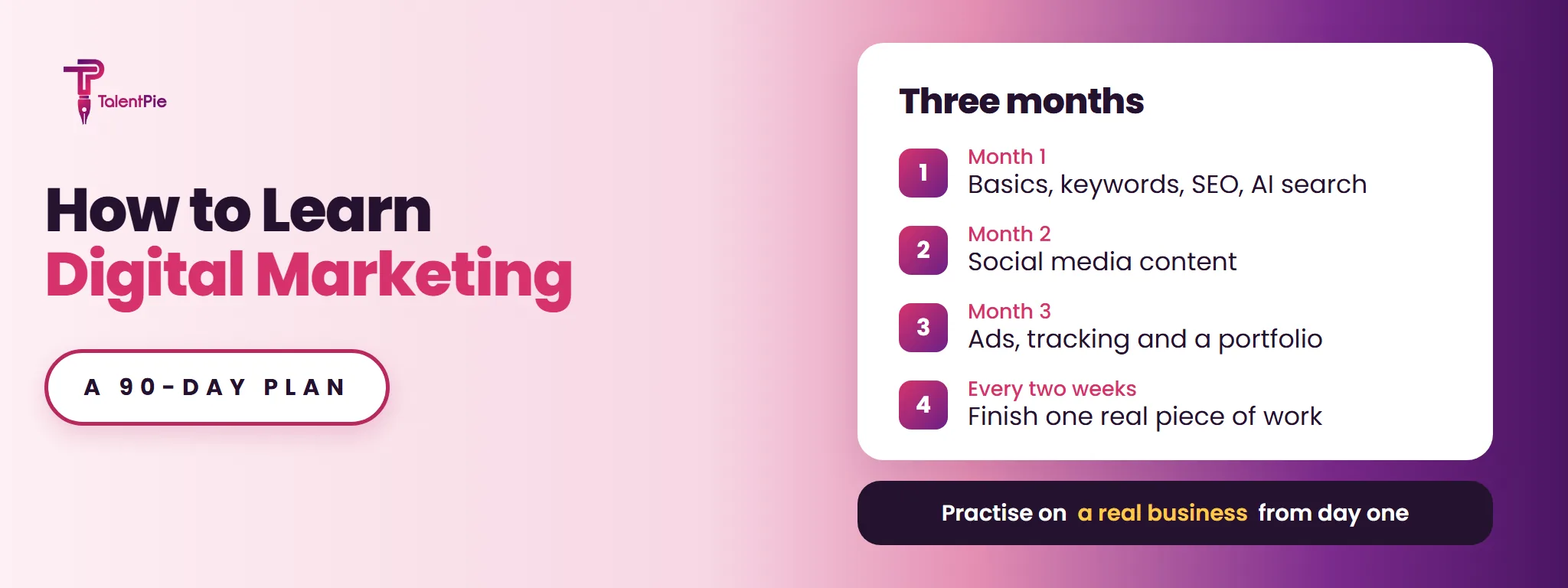
This plan fixes that. It's 90 days, about 8 to 10 hours a week, and every two weeks you finish one real piece of work. It follows the same order as our classroom course, so you can do it at home with free tools. Not sure yet what the field covers? Read what is digital marketing before day one.
Quick answer: To learn digital marketing, pick one real business to practise on. Learn in this order: marketing basics, then keyword research and SEO, then social media, then paid ads with tracking. Use free tools like Search Console and GA4. Finish a piece of work every two weeks. In about 90 days you'll have the basics and a small portfolio to show.
Can You Learn Digital Marketing on Your Own?
Yes, you can learn digital marketing on your own (online, for free) if you practise on a real website. The theory is all public. What's hard to get alone is feedback.
The big platforms publish free training for their own tools, because they want more people using them. You won't run short of things to read. The gap is somebody telling you that your keyword list mixes buyers with researchers, or that your ad copy promises something the landing page doesn't. Plan for that gap from day one. Find a friend who's learning too, or post your work in a community and ask for blunt comments.
What Do You Need Before You Start?
You need a laptop and basic English. Add a Google account and one business to practise on. You don't need coding. No design skills either, and no marketing degree.
The practice business matters most. It can be a relative's shop, a friend's tuition centre or a free blog you start about something you know well. Ask the owner for access to their Google Business Profile and Instagram, and ideally their website. A real business gives you real numbers, and real numbers are what interviewers ask about.
Block the time too. One hour on weekdays and a longer session at weekends works for most people. Studying in short daily bursts beats a single eight-hour Sunday.
What Does a 90-Day Plan to Learn Digital Marketing Look Like?
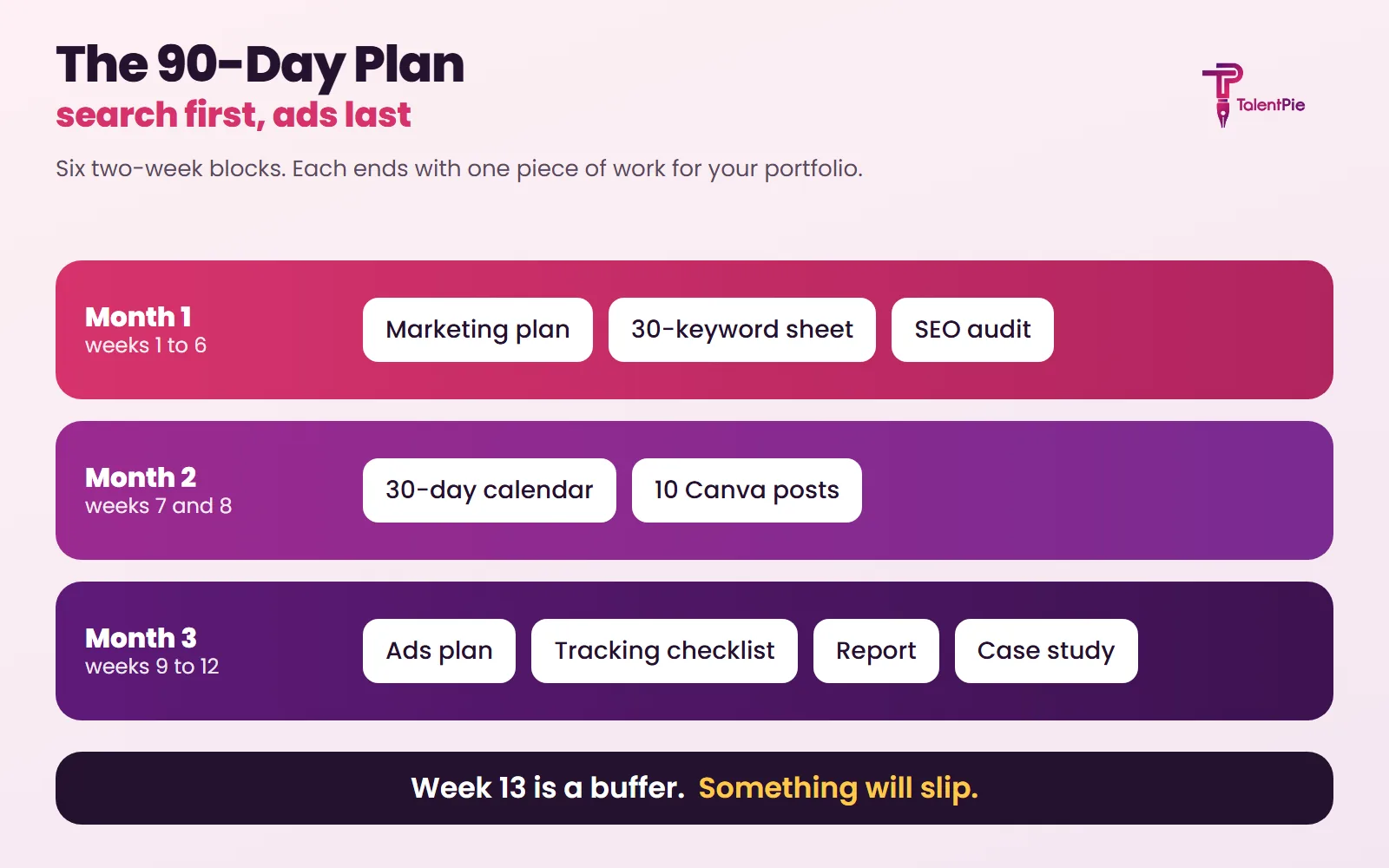
Three months, six two-week blocks, and one piece of work at the end of each block. Here's the plan.
| Weeks | What you learn | Free tools | What you finish |
|---|---|---|---|
| 1 to 2 | Marketing basics: customer, offer, goals | A notebook, Google Sheets | One-page marketing plan for your practice business |
| 3 to 4 | Keyword research and search intent | Keyword Planner, Google Trends | 30-keyword sheet grouped by intent |
| 5 to 6 | SEO (on-page, technical, local) and AI search | Search Console, Screaming Frog, Google Business Profile | SEO audit with the top five fixes |
| 7 to 8 | Social media content and community | Canva, Meta Business Suite | 30-day content calendar and 10 designed posts |
| 9 to 10 | Google Ads, Meta Ads and tracking | Google Ads, Meta Ads Manager, GA4 | Campaign plan with ad copies and a tracking checklist |
| 11 to 12 | Conversion, reporting and your portfolio | Microsoft Clarity, GA4, Search Console | Monthly report and one case study |
Use week 13 as a buffer. Something will slip, and that's fine.
Why Learn in This Order?
Because each block feeds the next one. Keyword research tells you what to post and what to bid on. Ads make no sense until you can measure them.
Beginners often jump straight to Instagram or Google Ads because that's where the action seems to be. It's a mistake. Without keyword research, your posts guess at what people want. Without tracking, your ad spend is a donation. Search first gives you the habit of starting from what customers actually type, and everything after that gets easier.
What Should You Do in Month 1?
Month 1 is about understanding the customer and learning search. By the end, you should know what your practice business's customers search for and why the website isn't showing up.
Weeks 1 and 2: marketing basics
Write down who buys from the business and what they need. Then write why they'd pick it over the shop down the road. Set one goal you can count, like 20 enquiries a month. This sounds too simple. It isn't. Plenty of the campaigns that come to our agency for fixing never had a clear goal in the first place.
Weeks 3 and 4: keyword research
Open Keyword Planner and Google Trends and build a sheet of 30 keywords. Then label each one. Is the person still researching? Comparing options? Ready to buy? "Best coaching for class 10 maths" and "maths tuition fees Gaur City" are different people at different stages.
Weeks 5 and 6: SEO and AI search
Connect Search Console and crawl the site with the free version of Screaming Frog. List the five biggest problems. Fix what you can: titles, a missing page, the Google Business Profile. Then rewrite one page so it opens with a clear answer and ends with real FAQs. That's the start of AI search work, which our guide to SEO vs AEO vs GEO explains in more depth. Google's own SEO Starter Guide is the best free reading for this block.
What Should You Do in Month 2?
Month 2 is social media, from planning posts to replying to comments. You'll end it with a month of content ready to post.
Pick three or four content themes for the business. A café might use new items and behind-the-counter clips. Customer photos work too. Build a 30-day calendar in Google Sheets. Design ten posts in Canva and script two Reels. Write captions in English and in Hinglish and see which gets more replies. Then spend a week replying to every comment in the brand's voice, and look at the insights in Meta Business Suite to decide what to post next month.
What Should You Do in Month 3?
Month 3 is paid ads with tracking. You also turn your work into a portfolio. This is where your earlier work pays off.
Weeks 9 and 10: ads and tracking
Set up GA4 conversions and UTM tags before anything else. Then plan a Google Ads search campaign from your keyword sheet and a Meta Ads campaign from your best posts. If the business owner agrees, run a small budget for a week. Watching real money buy real clicks teaches more than any video. If they don't agree, a written plan with ad copies is still good portfolio work.
Weeks 11 and 12: conversion, reporting and portfolio
Install Microsoft Clarity and watch twenty session recordings. Note where people get stuck. Write a one-page monthly report: what you did, what changed in the numbers, what you'd do next. Then turn your best piece of work into a short case study. Problem, action, result. That folder is what you'll show in interviews.
You'll need a handful of free tools along the way, all listed in our guide to digital marketing tools for beginners. If the terms are still blurry, our guide to the types of digital marketing maps out what each channel does.
How Can You Learn Digital Marketing for Free?
Use the free training from the platforms themselves, plus a real website to practise on. That combination covers most of a beginner's needs.
- Google Skillshop: free courses and certificates for Google Ads and Google Analytics.
- Google Search Central: the SEO Starter Guide and Google's own documentation on how search works.
- Meta Blueprint: free courses on Facebook and Instagram ads.
- YouTube: fine for single "how do I do X" questions, weak as a full course.
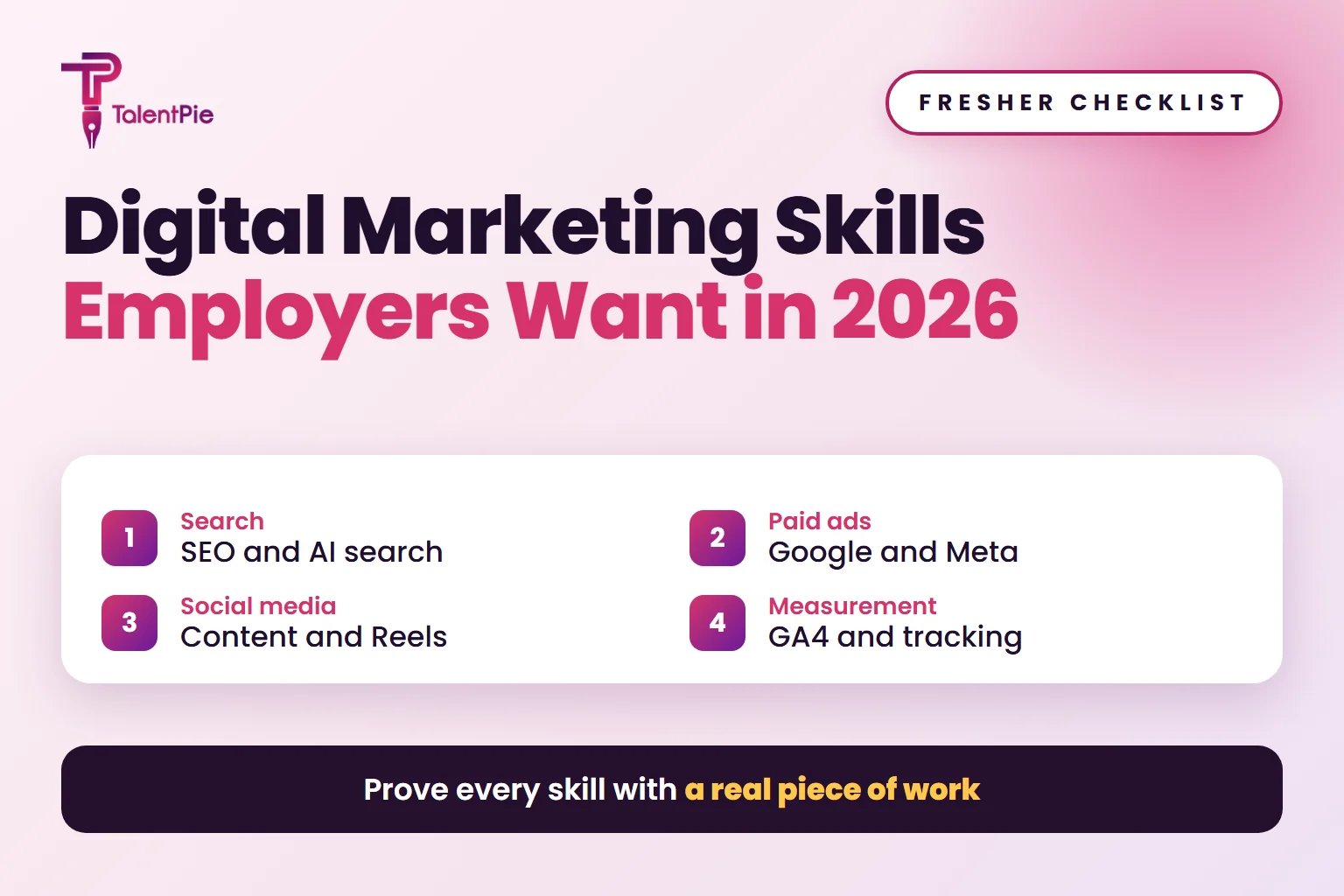
Free certificates are worth doing because they prove you've covered the basics. On their own, though, they rarely get you hired. Employers ask to see work. Our post on digital marketing skills employers want lists the exact pieces of proof they look for.
Self-Study or a Course: Which Is Better?
Self-study works if you're disciplined and can find feedback. A course suits you if you want structure and a mentor, plus real client work. The table puts them side by side.
| Self-study (this plan) | TalentPie course | |
|---|---|---|
| Cost | Free | ₹25,000 for 3 months, no registration fee |
| Feedback | You have to find it | A mentor reviews your work every week |
| Practice | Your own practice business | A live client project with Gary Global Solutions |
| Timetable | Your own | Weekdays 3 hours a day offline, or weekends 2 hours a day live online |
| Hours with a trainer | None | 180+ (weekday) or 50+ (weekend) |
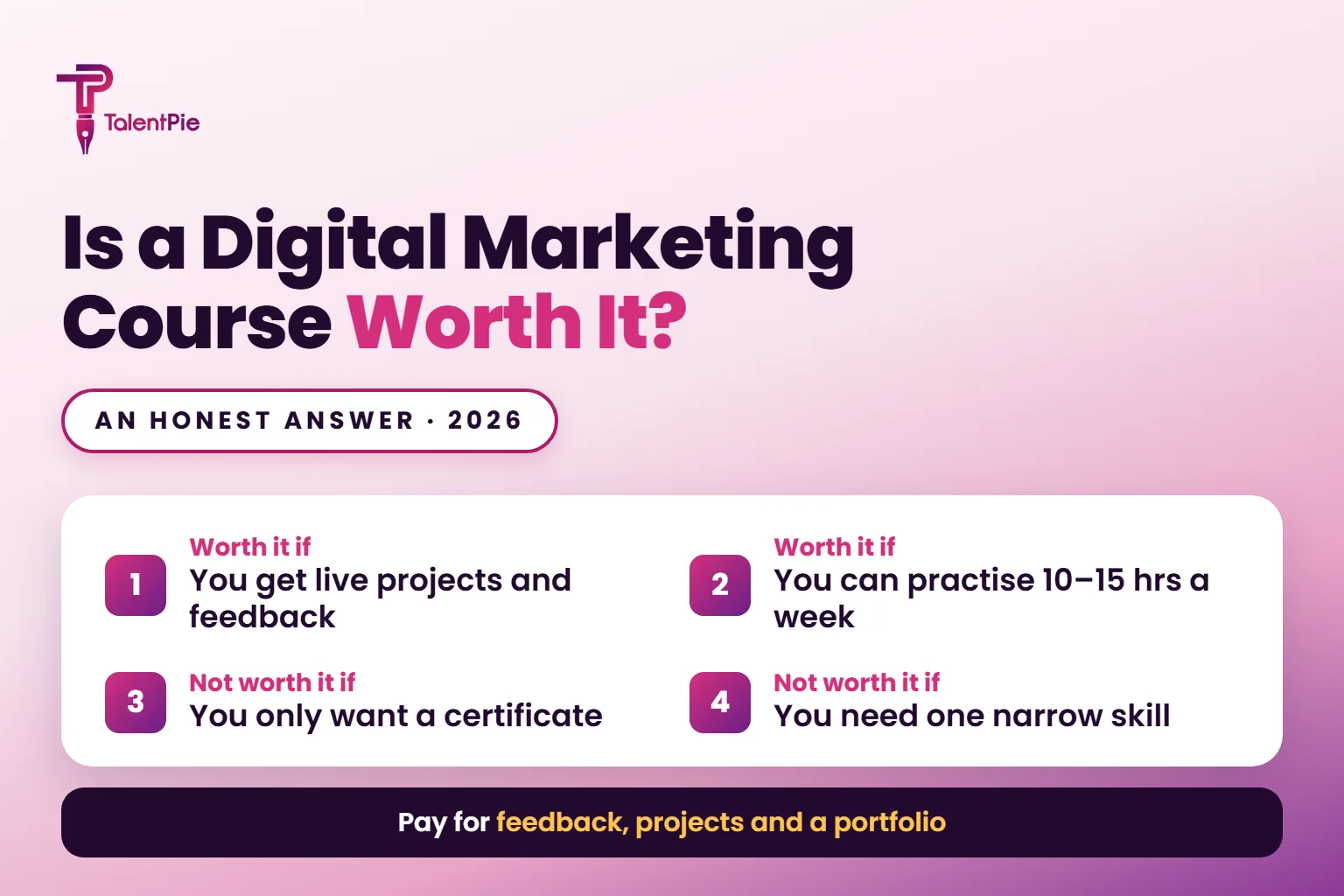
If you're weighing up the fee, our honest take on whether a digital marketing course is worth it lays out when it isn't. And if timing is the worry, our guide to digital marketing course duration shows what you can learn in one month versus three or six.
Can You Learn Digital Marketing at Home or Online?
Yes. Everything in this plan works from home with a laptop and an internet connection. The tools are all web-based.
If you want a trainer but can't travel, a live online class is the middle path. Our weekend online digital marketing course runs on Saturdays and Sundays, 11:00 AM to 1:00 PM IST. It follows the same syllabus as the classroom batch, and you do more of the practice at home between classes.
What Mistakes Should You Avoid?
The biggest mistake is learning without making anything. A few others come up every batch.
- Collecting certificates instead of work. Three certificates and no portfolio loses to one good audit report.
- Learning every tool at once. Get good at Search Console and GA4 first. The rest builds on them.
- Skipping tracking. If you can't prove a result, it didn't happen as far as a client is concerned.
- Practising on a dummy site only. Real businesses have messy data and real customers. That's the point.
- Trusting AI output blindly. ChatGPT will happily invent a search volume. Check it.
What Comes After the 90 Days?
After 90 days you'll have the basics; now pick one area and go deeper while you apply for work. Depth in one channel is what gets you a first job.
Our roadmap on how to become a digital marketer covers the next step. It walks through choosing a role and building the portfolio, then preparing for interviews. Keep practising on your business while you apply. A rising graph from your own work is the strongest thing you can bring to an interview.
Frequently Asked Questions
How do I start learning digital marketing?
Pick one real business to practise on, such as a relative's shop or your own blog. Then learn in a set order. Start with marketing basics and keyword research, then SEO. Social media comes next, and paid ads with tracking come last. Finish one piece of work every two weeks.
Can I learn digital marketing online?
Yes. All the main tools are web-based and the platforms publish free training. You can follow a self-study plan or join a live online class. TalentPie's weekend online batch runs Saturday and Sunday, 11:00 AM to 1:00 PM IST, for 3 months.
Can I learn digital marketing for free?
Yes. Google Skillshop and Google Search Central have free training, and so does Meta Blueprint. Free tools such as Search Console and GA4 are what agencies use every day. What's hard to get for free is feedback on your work, so find a study partner or mentor.
How long does it take to learn digital marketing?
About 90 days of steady practice, at 8 to 10 hours a week, is enough to learn the basics and build a small portfolio. Getting really good at one channel takes a year or more of real work.
Can I learn digital marketing at home?
Yes. All you need is a laptop with an internet connection, plus a business to practise on. Every tool in the 90-day plan works in a browser, so you can do the whole plan from home.
Do I need a degree or coding to learn digital marketing?
No. Digital marketing needs no degree and no coding. Basic English, comfort with simple numbers and regular practice matter far more. Employers judge you on the work you can show.
About the Author
Prateek Gupta is the founder of TalentPie and leads its digital marketing course. He teaches inside Gary Global Solutions, a working digital marketing agency in Greater Noida West, where students work on live client projects for real businesses. He shares practical lessons on his YouTube channel, Grow with Prateek Gupta.
Want a Mentor for Your 90 Days?
Our 3-month digital marketing course follows this exact order, with a mentor checking your work every week and a live client project at the end. Join the weekday batch at our Nx One campus in Greater Noida West. Or join the weekend batch online.
Book a free counselling call, or call us on 8826789578.