Last updated: 16 November 2026 · Written by Prateek Gupta, Founder & Educator, TalentPie
Let me be upfront. We run a paid digital marketing course, so you should read this knowing that. I'm still going to tell you who should not pay for one, because a student who joins for the wrong reason doesn't do well, and that helps nobody.
So, is a digital marketing course worth it in 2026? For a lot of people, yes. For some, clearly not. Below you'll find the real costs, what freshers earn, how AI has changed the picture, and a few simple tests to judge any course before you spend money on it.
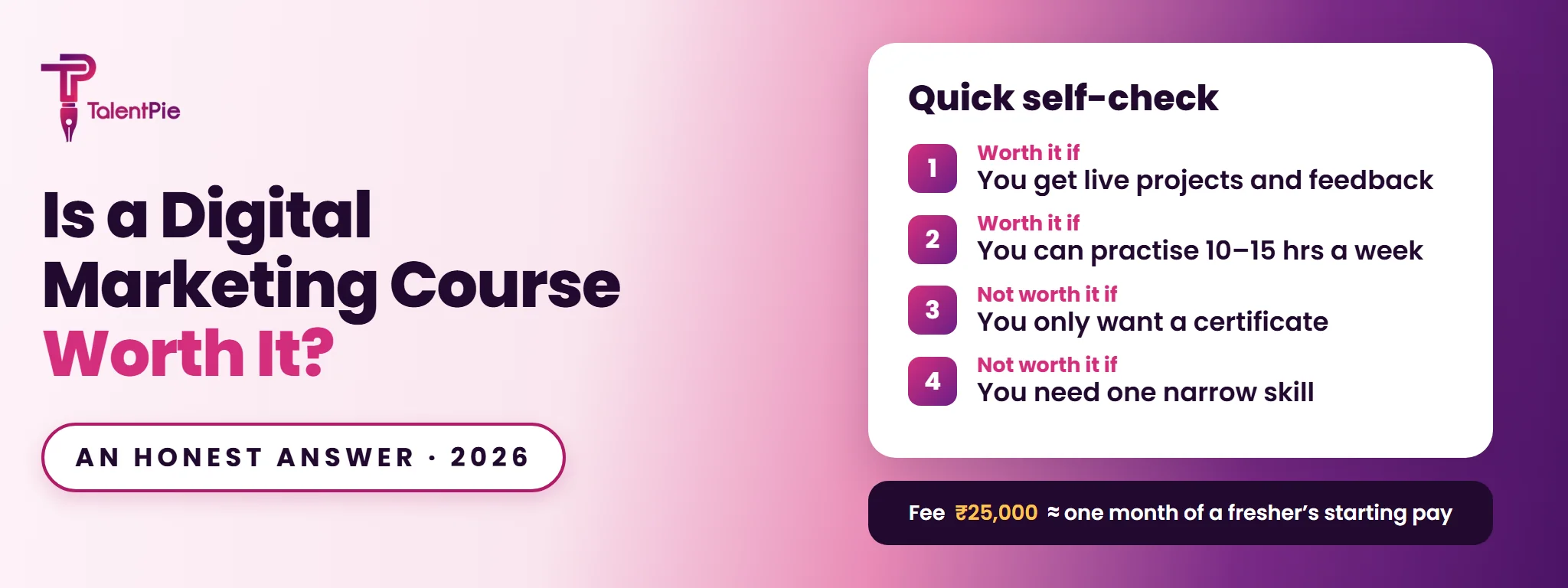
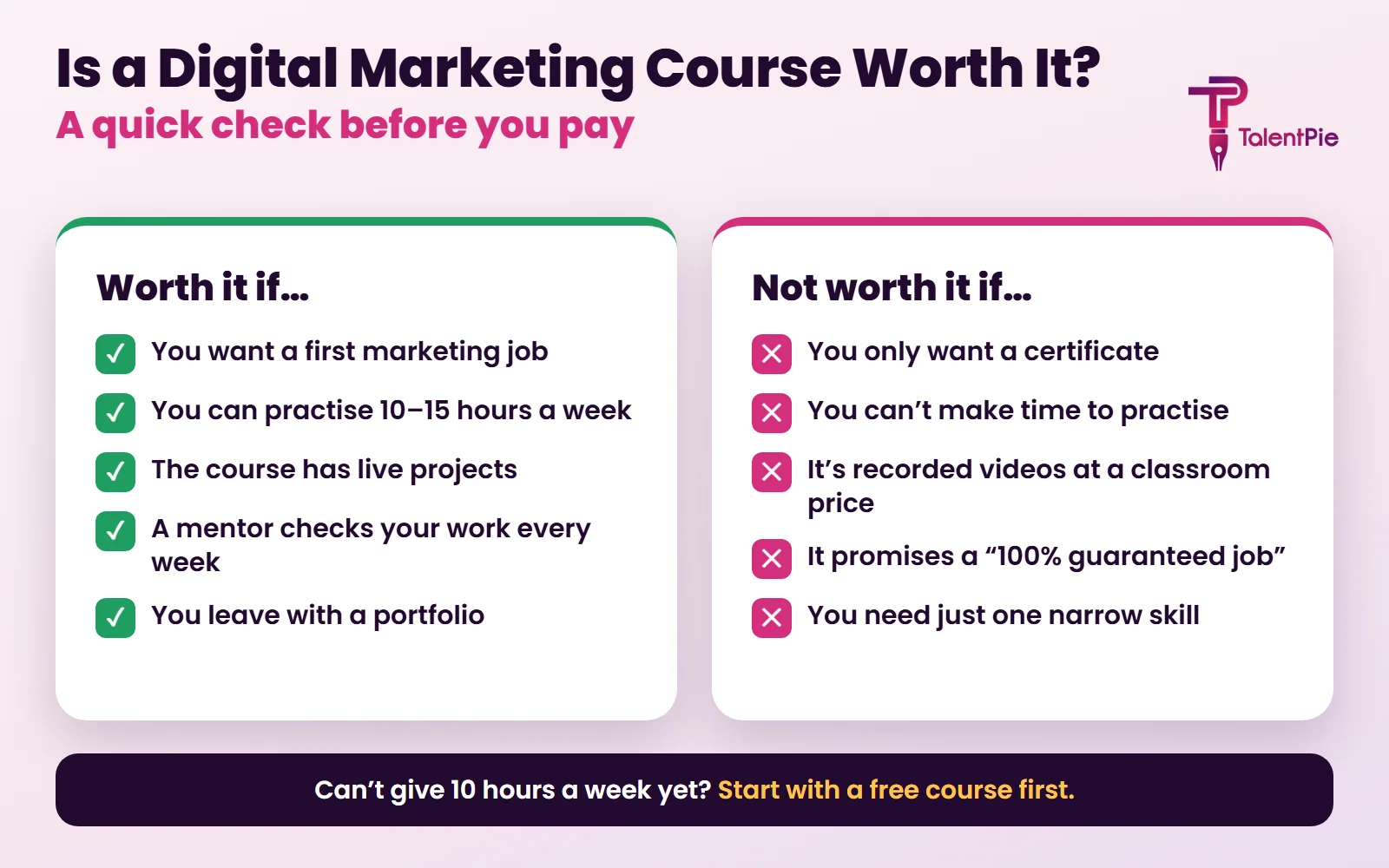
Quick answer: A digital marketing course is worth it if it gives you live projects, mentor feedback and a portfolio you can show an employer, and if you can practise 10 to 15 hours a week. It is not worth it if you only want a certificate, can't make time to practise, or already work in marketing and need just one skill.
Who Is a Digital Marketing Course Worth It For?
It is worth it for people who need structure, feedback and proof of work. That covers most beginners, but not everyone.
| Your situation | Worth paying? | Why |
|---|---|---|
| Fresher or graduate who wants a first marketing job | Usually yes | You need a portfolio, and building one alone is slow |
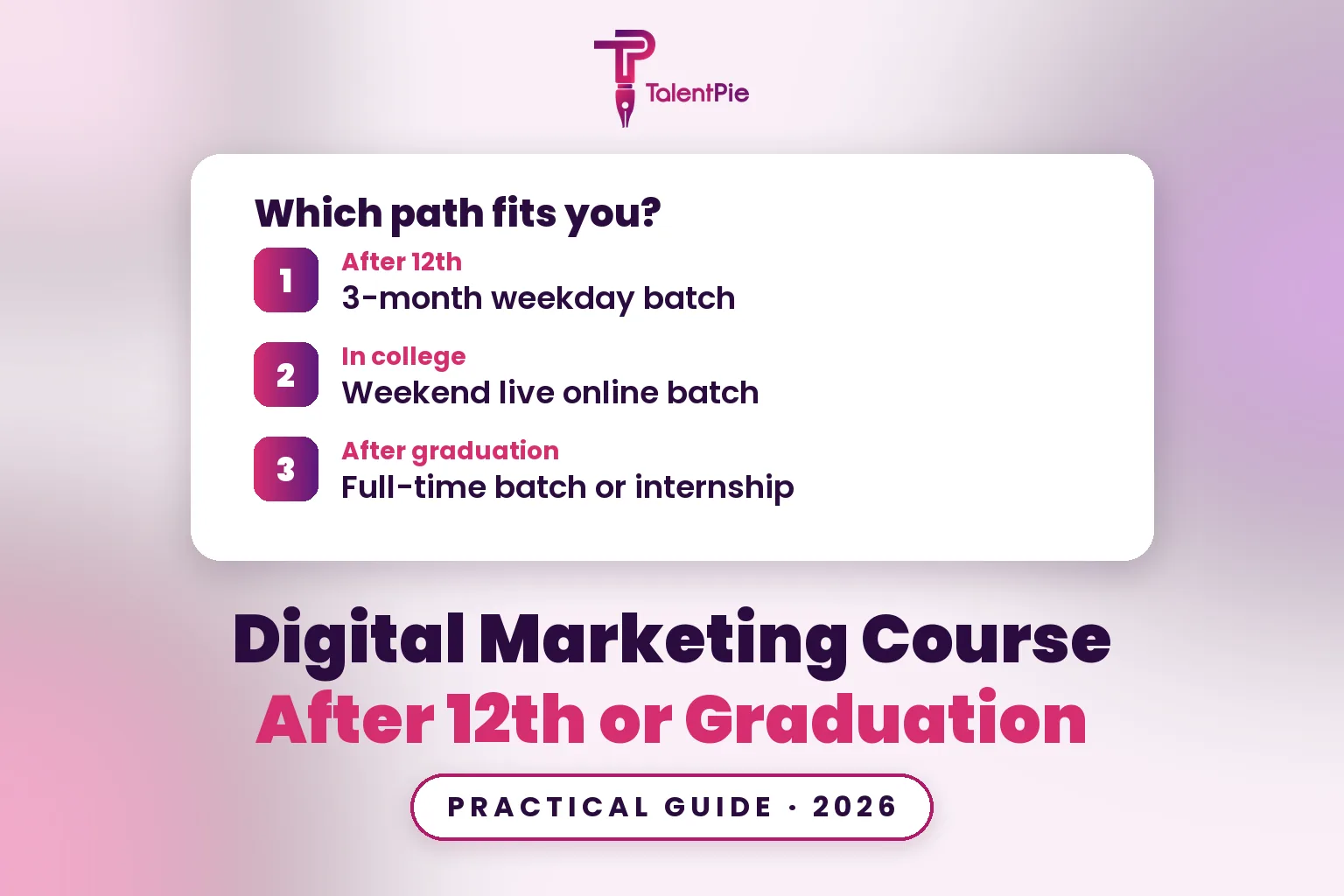
| Student after 12th or in college | Yes, if you can give the hours | Skills plus a degree stand out in placements |
| Career switcher from sales, HR or teaching | Often yes | A weekend batch gets you work samples without quitting |
| Small business owner | Yes, for the parts you'll use | You stop paying for work you can't judge |
| Already working in marketing | Rarely | A short course on one gap is cheaper |
| Someone who only wants a certificate | No | Employers hire on work shown, not paper |
The last row is the important one. A certificate alone rarely gets anyone hired in this field. Interviewers ask, "Show me something you did." If the course doesn't help you answer that, it isn't worth the fee, however cheap it is.
The Money: Course Fee vs What Freshers Earn
For most freshers, a mid-priced course costs less than two months of a first salary. The numbers below show why.
According to our guide to digital marketing salary in India, freshers usually see offers of ₹2.5 to 5 LPA. That works out to roughly ₹18,000 to ₹35,000 a month in hand. Our course costs ₹25,000 for the full 3 months, and the fee is the same for the classroom and the online batch.
So the fee is about one month's starting pay. That math only works if you actually get the job, though. Here is the full cost picture, including the parts brochures leave out:
| Cost | What to plan for |
|---|---|
| Course fee | ₹25,000 at TalentPie; check what's included elsewhere |
| Laptop | Needed for any serious course; a basic one works |
| Travel | Only for classroom batches; zero for live online |
| Your time | About 3 months of steady effort, 10 to 15 hours a week |
| Paid tools | Not needed to start; free tools from Google cover the basics |
Time is the cost people forget. Three months of half-hearted attendance gives you nothing to show. Three months of real practice gives you a portfolio. The fee is the same either way.
Has AI Made Digital Marketing Courses Useless?
No, but it has made bad courses useless. A course that only teaches definitions is now competing with a free chatbot, and losing.
The demand side is still growing. Digital advertising in India reached ₹71,621 crore in 2025, about 59% of all ad spending, according to a dentsu report. And IAMAI's Internet in India 2025 report counts 958 million active internet users, 44% of whom have used AI features such as voice search and chatbots.
What has changed is the work itself. Search now has AI Overviews and AI assistants, so marketers have to get brands cited in AI answers as well as ranked on Google. AI can draft a caption in seconds. It can't tell you which customer you're writing for, check that a claim is true, or explain to a client why leads dropped last week.
That's why a course in 2026 should teach AI as a tool inside real tasks, not as a separate trick. We explain how we do that on our AI digital marketing course page.
Free Courses vs a Paid Course: What Are You Paying For?
You pay for feedback, structure and real projects. The information itself is mostly free.
Google Skillshop, YouTube and free blogs cover a lot of theory, and they're good. If you're very disciplined and already have a project to practise on, such as a family business or your own website, free learning can work.
Here's where self-learners usually get stuck:
- Nobody checks your work. You can make the same mistake in every audit for months without knowing it.
- No real accounts. It's hard to practise Google Ads or Merchant Center without a live account and a budget.
- No deadline. Week three is where most self-study plans quietly stop.
- No order. You learn Reels before you understand who the customer is.
A good paid course fixes these four things. If it doesn't, you're paying for videos you could have watched for free.
Is a Digital Marketing Course Useful? Look at What You Leave With
A useful course ends with work you can show, not just notes. Ask any institute for its list of student deliverables.
In our 12-week course, each student finishes with about a dozen pieces, including:
- A 30-keyword matrix and a pillar-and-cluster topic map
- A technical SEO audit report built with Screaming Frog and Google Search Console
- An AEO/GEO page with FAQ schema, written to be quoted by AI answers
- A 30-day social media calendar and ten posts designed in Canva
- A Google Ads campaign plan with ad copies, and a Meta Ads tracking checklist
- A live client project from Gary Global Solutions, presented to the team
The full week-by-week list is in our digital marketing course syllabus. Our post on the digital marketing course with live projects shows how the client work runs.
Red Flags: When a Course Is Not Worth the Money
Walk away if you see any of these. They show up far too often in this industry.
- "100% placement guaranteed." No honest institute can promise a job. Ask to see the written policy.
- No live hours stated. If the brochure says "3 months" but not how many hours of teaching, ask. Then ask again.
- Recorded videos sold as a course. Fine if cheap. Not fine at a classroom price.
- Trainers who don't run campaigns. Ask what the trainer worked on last month.
- No project list. If they can't tell you what you'll build, you probably won't build much.
- A fee that changes on every call. A real fee is written on the website.
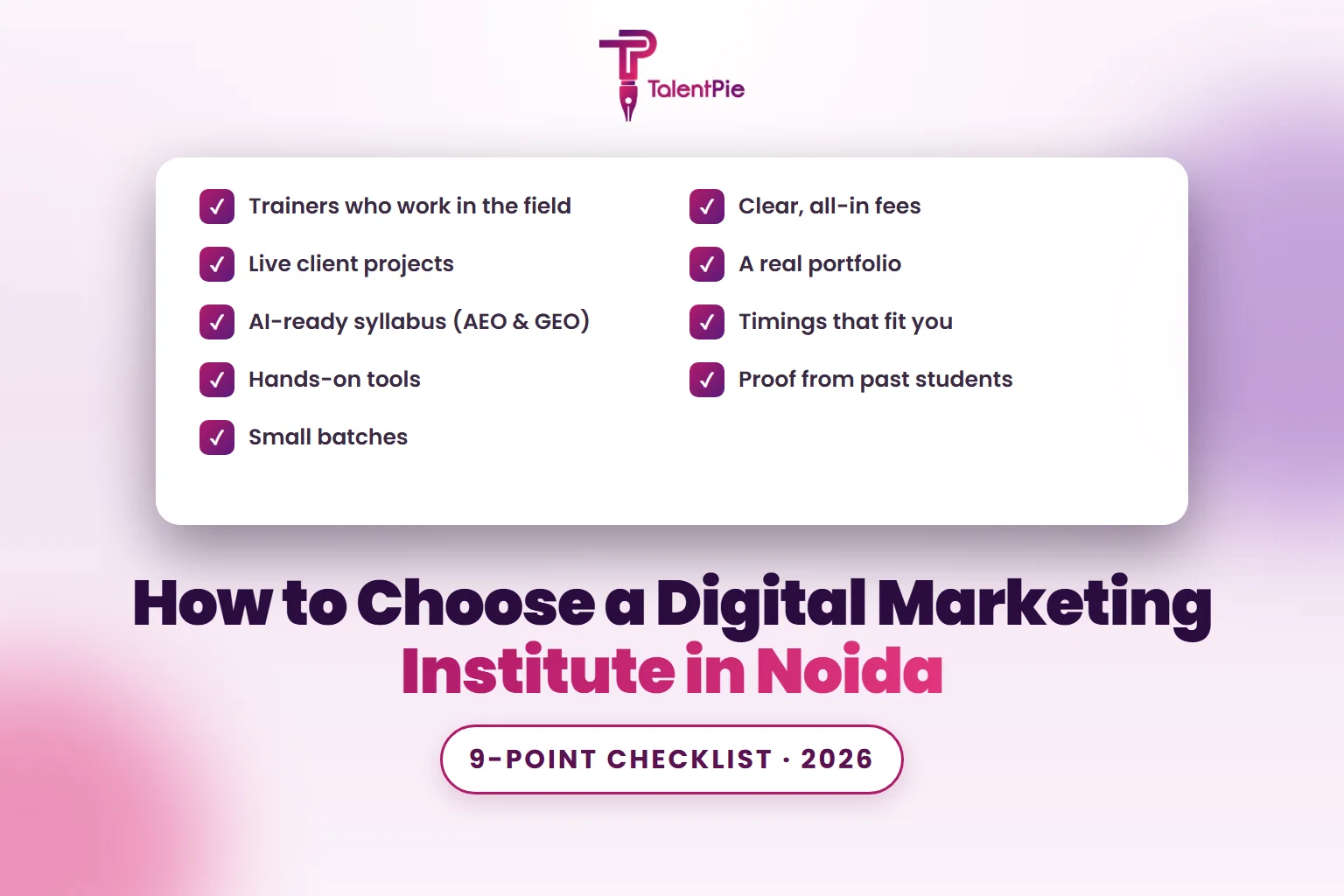
We wrote a longer checklist on how to choose a digital marketing institute if you're comparing options.
Digital Marketing Course Review: Test Any Course in Five Steps
Before you pay anyone, including us, do this:
- Sit in on a demo class. Watch whether students are doing work or just listening.
- Ask for the syllabus in writing. Check it week by week, with a deliverable for each week.
- Ask to see a student portfolio. One real example tells you more than ten testimonials.
- Read reviews outside the website. Google reviews from named people are a better signal than a slider on the homepage.
- Try a free module first. Spend one weekend on Google Skillshop. If you hate it, you've saved a fee.
When Would We Tell You to Wait?
Sometimes the honest advice on a counselling call is "not yet". We say it when:
- Your college exams are in the next two months. Finish them first.
- You can't give at least 10 hours a week right now.
- You want to "see what digital marketing is". A free course answers that faster and cheaper.
- You need one narrow skill for your current job. A short course is the better buy.
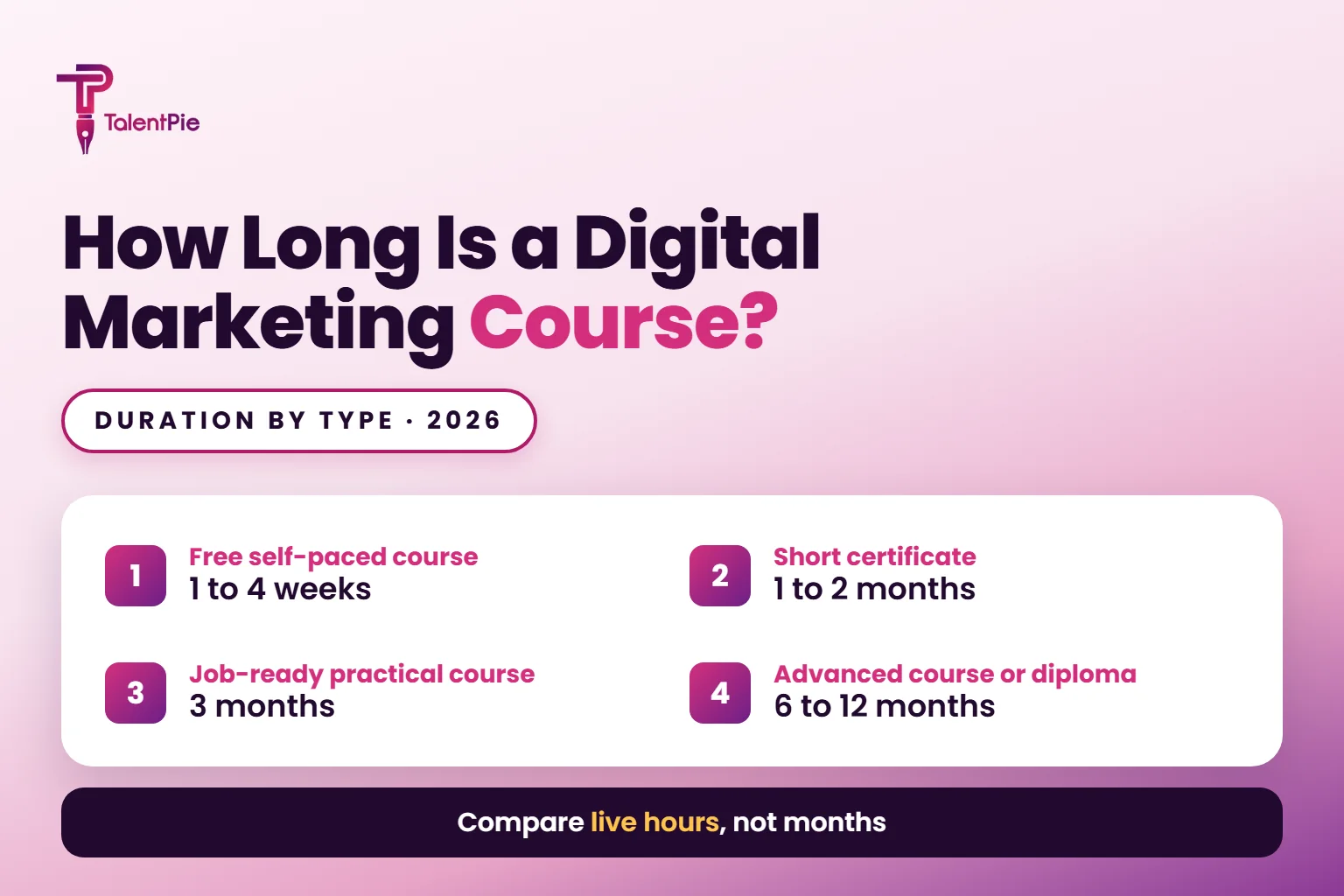
If none of these apply and you want a first job or real clients, a practical digital marketing course is usually money well spent. Wondering how long it will take? Our guide to digital marketing course duration breaks it down.
Frequently Asked Questions
Is a digital marketing course worth it in 2026?
Yes, for most beginners who will practise. A course is worth it when it includes live projects, mentor feedback and a portfolio. It is not worth it if you only want a certificate or cannot give 10 to 15 hours a week.
Is a digital marketing course useful for freshers?
Yes. Freshers are hired on proof of work, and a good course helps you build that proof in about 3 months. Fresher salaries in India usually start between ₹2.5 and 5 LPA, depending on the role, city and portfolio.
Is a digital marketing course good or bad?
It depends on the course. A practical course with live hours, real projects and named trainers is good value. A recorded-video course sold at a classroom price, or one that promises guaranteed jobs, is a poor choice.
Can I get a job after a 3-month digital marketing course?
Many people do, but the course length is not what gets you hired. Employers look at your work samples, your understanding of tools such as Google Search Console and GA4, and how clearly you explain your results.
Is a free digital marketing course enough?
A free course is enough to learn the basics and test your interest. Most people still need feedback, real accounts and deadlines to become job-ready, and that is what a good paid course adds.
What is the value of a digital marketing certificate?
On its own, not much. A certificate helps when it comes with a portfolio. Free certifications from Google Skillshop are worth adding to your CV, since they cost nothing and show initiative.
Is a digital marketing course worth it for business owners?
Yes, if you will use what you learn. Owners who understand SEO, Google Business Profile and ads can judge agency work, avoid wasted budgets and handle simple tasks themselves.
About the Author
Prateek Gupta is the founder of TalentPie and leads its digital marketing course. He teaches inside Gary Global Solutions, a working digital marketing agency in Greater Noida West, where students work on live client projects across SEO, AEO, GEO, social media and paid ads. He shares practical lessons on his YouTube channel, Grow with Prateek Gupta.
Still Deciding? Ask Us the Hard Questions
Bring your doubts to a free counselling call. Ask about the fee, the hours, the projects and the trainers. If a course isn't the right step for you yet, we'll tell you.
Book a free counselling call, or call us on 8826789578.