How to Become a Digital Marketer: Complete Career Roadmap
You don't need an engineering degree, an MBA, or a background in computer science to become a digital marketer. What you actually need is a willingness to learn a handful of core skills, apply them on real projects, and keep improving as tools and platforms change. That's really the honest answer to how to become a digital marketer - there's no shortcut, but there's also no gatekeeping degree standing in your way.
This roadmap is built for students, fresh graduates, working professionals switching careers, and complete beginners with zero technical background. Whether you've just finished 12th or you're five years into an unrelated job and want a change, the path looks largely the same: learn the fundamentals, build core skills one at a time, create real projects, and use those projects to get your first opportunity.
What Does a Digital Marketer Do?
A digital marketer helps a business get discovered online, convert visitors into leads or customers, and retain those customers over time. The exact daily work varies a lot depending on the company, the industry, and whether you're a generalist or a specialist.
Key Responsibilities of a Digital Marketer
SEO (Search Engine Optimization): This means improving a website so it shows up when people search for relevant terms on Google. A typical task might be researching what keywords a competitor ranks for and updating an underperforming blog post to target better search terms.
Content marketing: Planning and creating blog posts, videos, or guides that answer real questions a target audience is searching for - not just publishing content for the sake of it.
Social media: Running organic content calendars, engaging with comments, and sometimes managing paid promotion on platforms like Instagram, LinkedIn, or Facebook.
Paid advertising: Setting up and optimizing campaigns on Google Ads or Meta Ads, tracking cost per lead, and adjusting targeting or creatives based on performance.
Email marketing: Building sequences that nurture leads - welcome emails, abandoned cart reminders, newsletters - and tracking open and click rates.
Lead generation: Designing landing pages, forms, and offers that convert website traffic into actual business inquiries.
Analytics: Reading data from Google Analytics or Looker Studio to understand what's working and what isn't, then reporting that back in a way stakeholders can act on.
Conversion optimization: Testing headlines, page layouts, or call-to-action buttons to improve how many visitors take a desired action.
In a small company, one person might touch all of these. In a larger company, each of these becomes its own specialist role.
Where Do Digital Marketers Work?
Digital marketers are employed across a wide range of setups:
- Digital marketing agencies - handling multiple client accounts across industries, which is often the fastest way to gain varied experience
- Startups - where you'll likely wear several hats and learn quickly out of necessity
- E-commerce companies - with heavy focus on paid ads, conversion rate, and retention
- SaaS companies - where content marketing and lead nurturing tend to matter more
- MNCs - with more structured, specialized roles and bigger budgets
- Freelancing and consulting - for those who prefer working independently once they have proven skills
How to Become a Digital Marketer Step by Step
Step 1: Learn the Fundamentals of Digital Marketing
Before touching any tool, it helps to understand a few core marketing concepts. Skipping this step is the reason many beginners can operate a tool but can't explain why a campaign isn't working.
Get comfortable with ideas like the marketing funnel (awareness, consideration, decision), target audience definition, buyer personas, the customer journey, basic branding principles, what makes content effective, and what actually counts as a conversion for a given business. None of this requires a course by itself - an hour of focused reading and a few real examples will get you there.
Understanding these fundamentals first means that when you later learn Google Ads or SEO, you're learning how to apply strategy - not just clicking buttons in a dashboard.
Step 2: Learn the Core Digital Marketing Skills
Most beginners make the same mistake: they try to learn SEO, Google Ads, Instagram, email marketing, and analytics all at the same time. A better approach is to learn one skill at a time, in a logical order, and actually practice each before moving to the next.
SEO - Learn how search engines rank pages and how to optimize content for both users and search engines. Practice by picking one topic, researching its keywords, and writing an optimized piece of content around it.
Content Marketing - Learn how to plan content around what your audience is actually searching for, not just what feels interesting to write about. Practice by outlining a month's worth of blog topics for a hypothetical business.
Social Media Marketing - Learn how different platforms serve different purposes (LinkedIn for B2B, Instagram for visual brands, etc.). Practice by building a one-month content calendar for a small business.
Google Ads - Learn keyword-based paid search, ad copywriting, and budget management. Practice with a small, controlled test budget once you understand the basics.
Meta Ads - Learn audience targeting and creative testing on Facebook and Instagram. Practice by building a sample campaign structure, even before spending real money.
Email Marketing - Learn how to build a simple welcome sequence and understand open/click metrics. Practice by drafting a 3-email nurture sequence for a fictional product.
Analytics - Learn to read traffic sources, bounce rate, and conversion data in Google Analytics. Practice by auditing a real (with permission) or sample website's traffic report.
Conversion Optimization - Learn how small changes to a landing page affect results. Practice by rewriting a weak landing page headline and explaining why your version should perform better.
Step 3: Learn Digital Marketing Tools
You don't need to master every tool that exists. Focus on the ones that are actually used daily in most digital marketing roles.
- Google Analytics - tracks website traffic and user behavior
- Google Search Console - shows how your website performs in Google search results
- Google Ads - the platform for running search and display ad campaigns
- Meta Ads Manager - the platform for Facebook and Instagram advertising
- Google Keyword Planner - helps with keyword research and search volume estimates
- SEMrush or Ahrefs - used for competitor research, keyword tracking, and backlink analysis
- Canva - for creating social media graphics and simple design assets without a design background
- WordPress - the most commonly used platform for building and managing websites
- Looker Studio - for turning raw analytics data into readable reports and dashboards
- AI tools - increasingly used for research, content drafts, and campaign ideation (more on this below)
Learning a tool is easy. Understanding why you're using it for a specific business goal is what actually makes you employable.
Step 4: Choose a Digital Marketing Specialization
Once you've had exposure to the core skills, it's worth understanding the field broadly before picking a lane. Trying to specialize on day one, before you know what you enjoy or where you're strong, often backfires.
|
Specialization |
What You Learn |
|
SEO |
Organic traffic and search visibility |
|
PPC |
Paid advertising |
|
Social Media |
Growth and engagement |
|
Content Marketing |
Content strategy |
|
Email Marketing |
Retention and automation |
|
Performance Marketing |
ROI-focused campaigns |
|
Analytics |
Data and marketing performance |
Most professionals end up specializing after 1-2 years of generalist experience, once they've discovered what kind of work they're naturally good at and actually enjoy doing day to day.
Learn AI for Digital Marketing
How AI Is Changing Digital Marketing
AI hasn't replaced digital marketing strategy, but it has changed how quickly certain tasks get done. Content research that used to take hours can now be sped up significantly. Ad copy variations that once required multiple drafting sessions can be generated and refined faster. Analytics tools increasingly surface insights automatically instead of requiring a marketer to dig through raw numbers. Search itself is also changing - AI-generated summaries are now part of how people find answers, which affects how content needs to be structured.
AI Skills Every Digital Marketer Should Learn
- AI-assisted content research and ideation
- Keyword clustering using AI tools
- Competitor research acceleration
- Ad copy generation and testing variations
- Creative asset generation for quick concepting
- Data analysis support for spotting patterns faster
- Marketing automation workflows
- AI search optimization (covered below)
AI is a productivity multiplier, not a replacement for judgment. A tool can draft ten headline variations in seconds, but deciding which one actually fits the brand, audience, and campaign goal still depends on a marketer's strategic thinking and experience.
AEO, GEO and AI Search Optimization
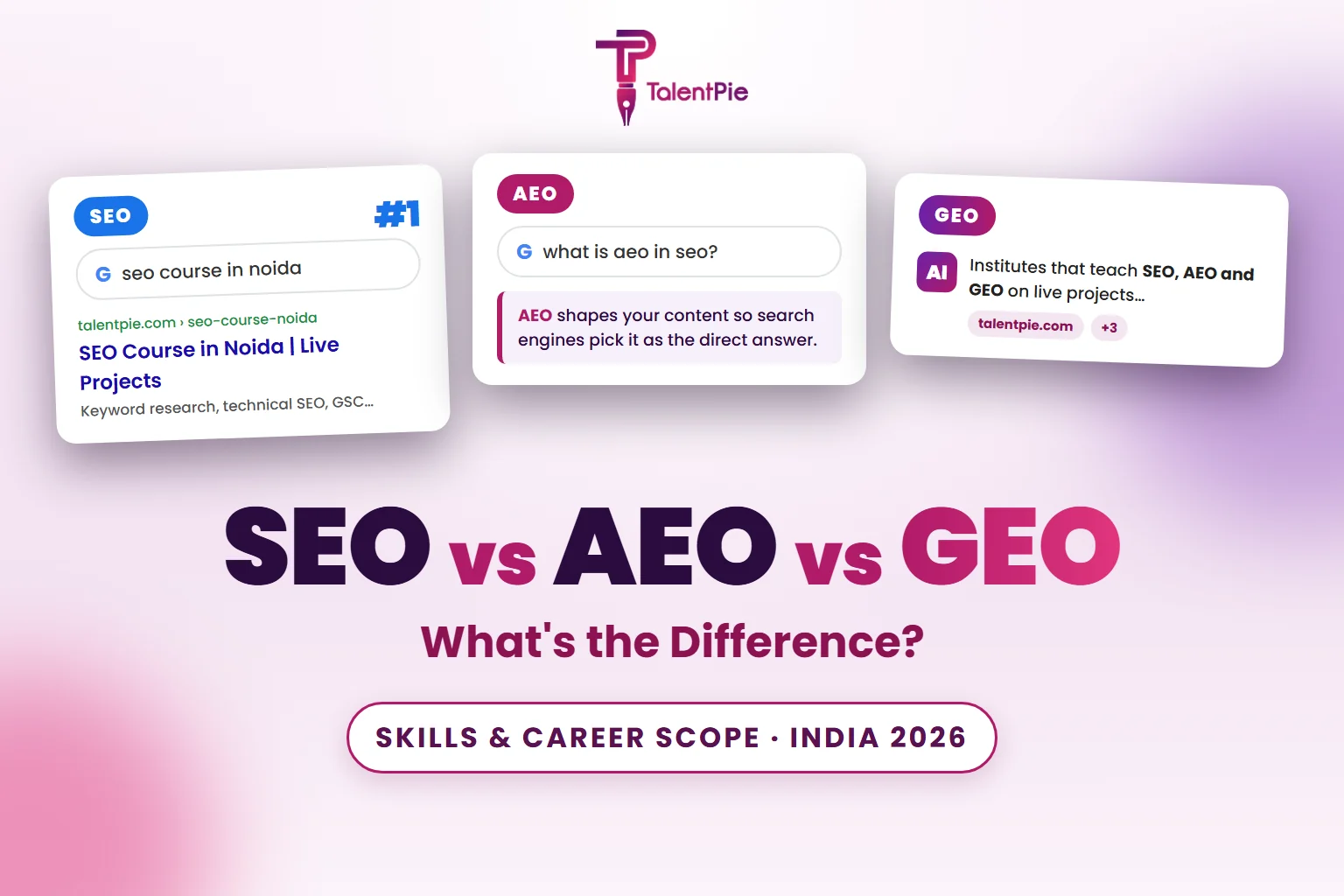
Search is no longer limited to a list of blue links. AEO (Answer Engine Optimization) focuses on structuring content so it can be pulled directly into AI-generated answers. GEO (Generative Engine Optimization) is about optimizing for how generative AI tools summarize and present information from your content. Both are extensions of good SEO fundamentals - clear structure, direct answers, and genuinely useful content - adapted for a search landscape where AI systems, not just users, are reading your pages.
For a beginner, the practical takeaway is simple: write content that answers questions clearly and directly, structure it with proper headings, and don't rely purely on keyword tricks that used to work for traditional search alone.
Build Practical Digital Marketing Experience
Certificates show that you sat through a course. They don't show that you can actually do the work. This is one of the most common gaps between beginners who get hired and those who don't.
Start Your Own Website or Blog
A personal website or blog is the cheapest, most flexible practice ground you'll ever have. Use it to practice keyword research, on-page SEO, content creation, internal linking, and connecting Google Search Console and Analytics to see real (even if small) traffic data.
Create Social Media Projects
Pick a small, real, or hypothetical business and build a one-month social media strategy for it - content pillars, posting frequency, sample captions, and a rationale for each choice. This becomes a tangible artifact you can show, not just a skill you claim to have.
Run a Small Test Campaign
Once you understand Google Ads or Meta Ads basics, run a very small, controlled test campaign - even with a modest budget of a few hundred rupees - to understand how targeting, bidding, and ad copy actually perform in a live environment. The goal is learning, not results at scale, so keep spending controlled and intentional.
Practice SEO on a Real Website
If you have access to any real website - your own, a friend's small business, or a local shop willing to let you help - practice tasks like fixing meta titles and descriptions, improving page speed basics, building an internal linking structure, or identifying content gaps against competitors.
Create Marketing Case Studies
Document your projects properly: the problem you were solving, the strategy you chose, how you executed it, what tools you used, the results (realistic ones, even if modest), and what you learned. This is what separates someone who "took a course" from someone who can actually walk an interviewer through real decision-making.
Don't just collect certificates. Build proof of your skills.
Build a Digital Marketing Portfolio
What to Include in Your Portfolio
- An SEO project (before/after or strategy document)
- A social media project or content calendar
- A sample Google Ads campaign structure
- Content writing samples
- A keyword research document
- A website audit
- An analytics report you created
- Any campaign results, even from small tests
- One or two detailed case studies
How to Build a Portfolio Without a Job
This is the question most beginners get stuck on: how do you show experience before anyone gives you a job? The answer is that experience doesn't have to come from paid employment. Self-created projects, volunteer work for local businesses, small assignments during an internship, or even a well-documented practice campaign all count as legitimate proof of ability. Employers hiring freshers generally understand that formal experience is limited - what they're actually evaluating is whether you can think through a marketing problem and execute on it.
Get Your First Digital Marketing Job
Best Digital Marketing Jobs for Freshers
- Digital Marketing Executive - generalist role touching multiple channels
- SEO Executive / SEO Analyst - keyword research, on-page optimization, reporting
- Social Media Executive - content calendars, posting, community engagement
- Content Executive - writing and content planning
- PPC Executive - managing and optimizing paid campaigns
- Performance Marketing Executive - ROI-focused campaign management
- Digital Marketing Intern - support role across multiple functions, common entry point
How to Get Your First Digital Marketing Job
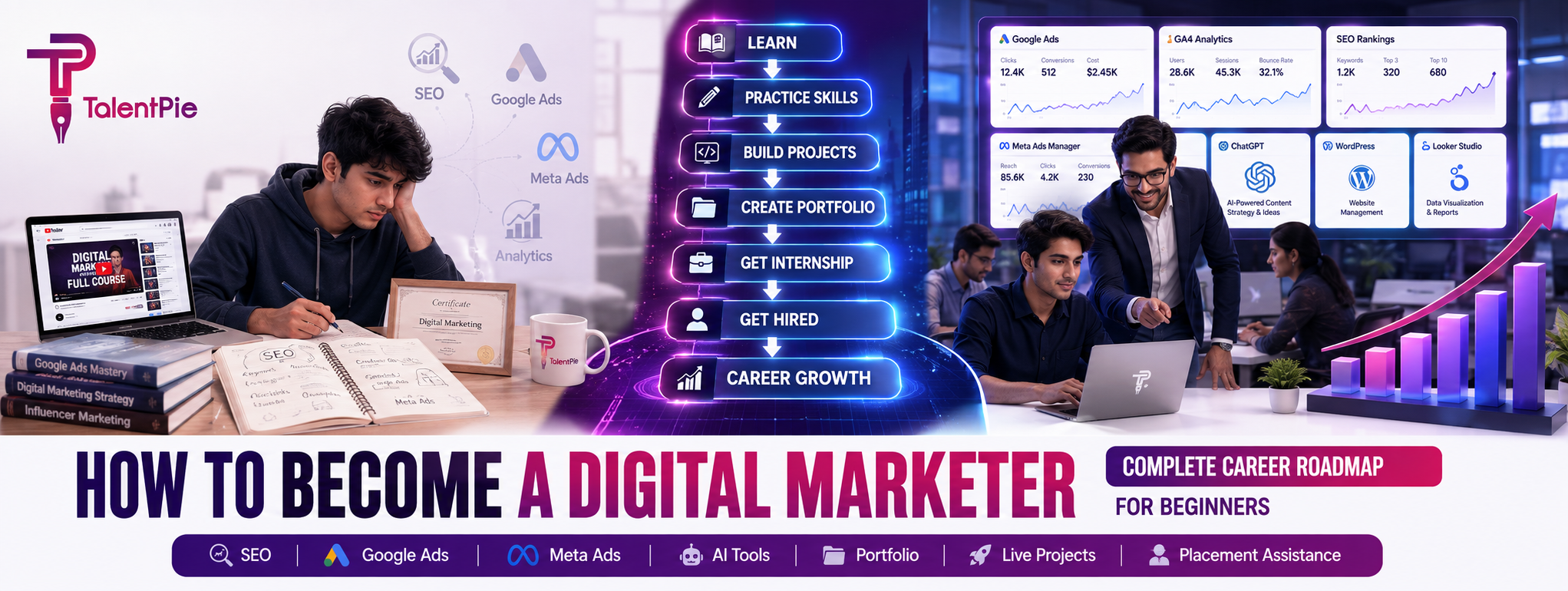
The realistic progression looks like this: Learn → Practice → Portfolio → Internship → Apply → Interview → Job.
For your resume, lead with your projects and case studies, not just course names. For your portfolio, keep it simple and organized rather than exhaustive - three or four strong projects beat ten shallow ones. For interviews, be ready to explain the reasoning behind decisions you made in your projects, since that's usually what separates candidates at the fresher level.
What Qualifications Do You Need to Become a Digital Marketer?
Can You Become a Digital Marketer Without a Degree?
Yes. Digital marketing is one of the more accessible career fields because hiring tends to prioritize demonstrated skill and a solid portfolio over formal degrees, especially at the entry level.
Can Students Become Digital Marketers?
Yes. Many students start by managing social media for a college club or small local business, or by freelancing part-time while studying, which gives them a head start by the time they graduate.
Can You Become a Digital Marketer Without Experience?
Yes, though "without experience" doesn't mean without proof of skill. Self-created projects, internships, and small freelance assignments can substitute for traditional work history when you're just starting out.
Should You Take a Digital Marketing Course?
This depends on how you learn best and how much structure you need.This depends on how you learn best and how much structure you need.
|
Self-Learning |
Digital Marketing Course |
|
Flexible |
Structured |
|
Usually cheaper |
Guided learning |
|
Requires discipline |
Mentor support |
|
Feedback may be limited |
Practical feedback |
|
Projects are self-created |
Project-based learning |
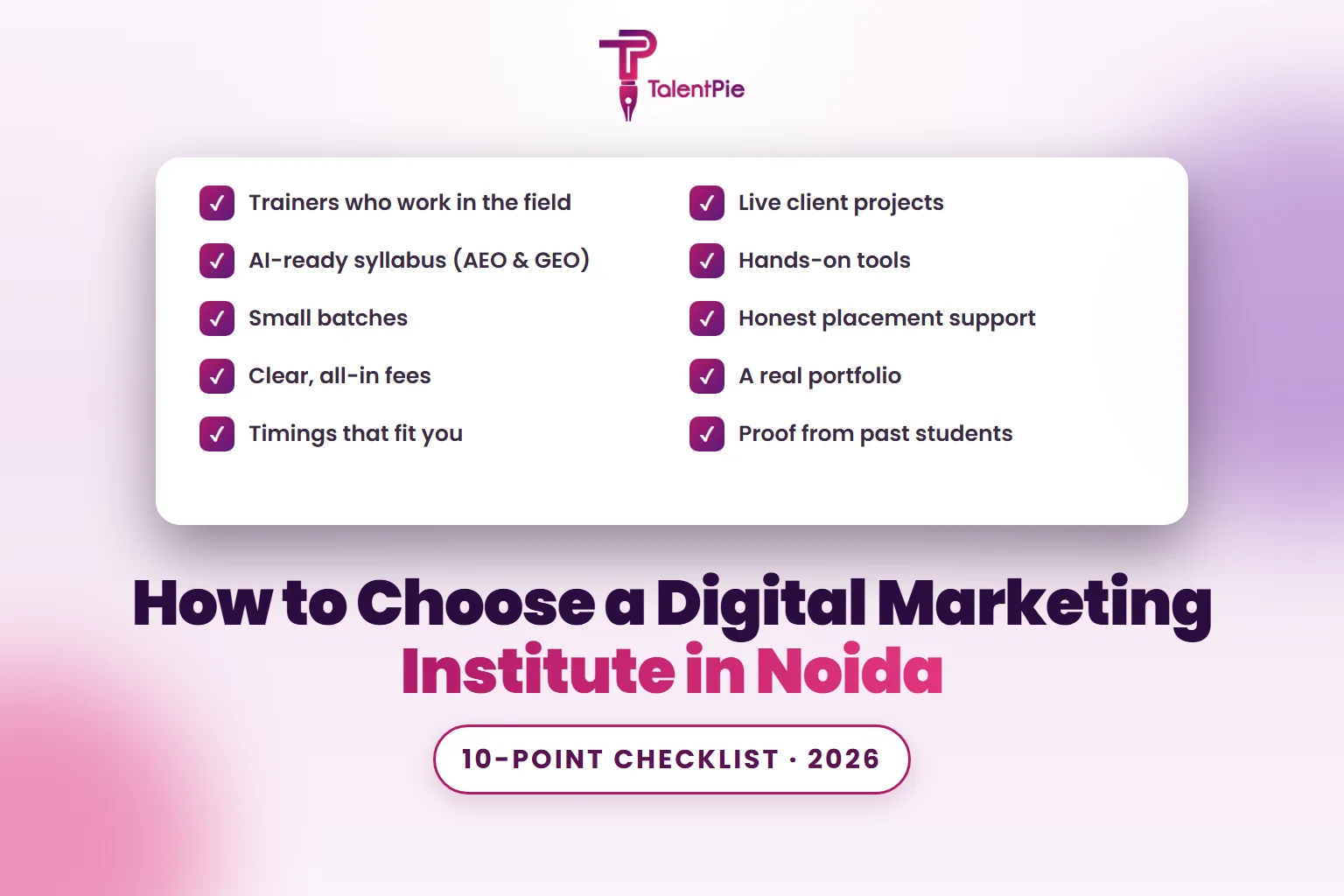
Self-learning works well if you're disciplined, enjoy figuring things out independently, and don't mind a slower, trial-and-error pace. A structured course tends to help more if you want mentor feedback on your work, a set curriculum instead of piecing one together yourself, and hands-on projects built into the learning process rather than something you have to create entirely on your own.
If you'd prefer a structured, practical route, TalentPie's [Digital Marketing Course in Noida] is built around live client projects rather than only theory, and covers SEO, AEO, GEO, social media, performance marketing, and AI tools as part of the curriculum, along with placement assistance for learners preparing for their first role.
Digital Marketing Career Path
Beginner / Intern
Learning fundamentals, assisting with execution, building first projects under supervision.
Digital Marketing Executive
Handling day-to-day tasks across one or more channels — content, social, ads, or SEO — with more independence.
Specialist
SEO Specialist / PPC Specialist / Social Media Specialist — going deep into one channel, owning strategy for that area.
Digital Marketing Manager
Overseeing campaigns across channels, managing a small team, reporting to leadership on overall performance.
Head of Digital Marketing
Setting overall marketing strategy, owning budgets, and aligning digital efforts with broader business goals.
Digital Marketing Salary in India
Digital marketing salaries in India vary widely based on experience, location, company size, specific skills, specialization, industry, and individual performance - so treat any number here as a general reference point, not a guarantee.
Digital Marketing Salary for Freshers
Entry-level roles typically start modestly and vary significantly by city and company type, with metro cities and agencies handling larger clients generally paying more than smaller setups.
Digital Marketing Salary After 2–3 Years
Compensation tends to grow meaningfully once you have a specialization and a track record of results you can point to in interviews.
Digital Marketing Manager Salary
Manager-level pay reflects both experience and scope of responsibility, and can vary substantially between a small agency and a large company managing bigger budgets.
Freelance Digital Marketing Income
Freelance income depends entirely on the number and size of clients, your specialization, and your ability to consistently deliver results - it can range from a side income to a full-time livelihood depending on how it's built up over time.
For current, India-specific salary data, cross-check listings on platforms like Glassdoor, AmbitionBox, or Naukri, since figures shift over time and by region.
Skills You Need to Become a Successful Digital Marketer
Technical Skills
SEO, PPC, social media management, content creation, analytics, email marketing, familiarity with AI tools, and basic marketing automation.
Soft Skills
Communication, creativity, analytical thinking, copywriting, problem-solving, presentation skills, and adaptability. These matter more than people expect - a marketer who can analyze data but can't communicate findings to a non-technical stakeholder, or who can write well but can't adapt when a campaign underperforms, will struggle regardless of technical knowledge.
Common Mistakes Beginners Make in Digital Marketing
Learning Too Many Tools at Once
Fix: Focus on one skill at a time and get genuinely comfortable before moving on.
Focusing Only on Certificates
Fix: Pair every certificate with at least one real or simulated project.
Not Building Projects
Fix: Start a personal blog or small project immediately, even before you feel "ready."
Ignoring Analytics
Fix: Make reading Google Analytics or Search Console a weekly habit, not an afterthought.
Applying for Jobs Without a Portfolio
Fix: Build even a simple 3-project portfolio before you start applying.
Not Learning AI
Fix: Spend a few hours understanding how AI tools fit into research, content, and reporting workflows.
6-Month Digital Marketing Career Roadmap
Month 1: Digital marketing fundamentals + SEO basics
Month 2: Content marketing + social media + keyword research
Month 3: Google Ads + Meta Ads + analytics
Month 4: Build real projects + start your portfolio
Month 5: Internship or freelance work + document case studies
Month 6: Job applications + interviews + begin specializing
Learning speed varies from person to person - some people move faster with focused daily practice, others need more time, especially while balancing college or a job. Treat this as a realistic guide, not a fixed deadline.
Digital Marketing Career Roadmap at a Glance
Understand Marketing → Learn Core Skills → Learn Tools → Choose Specialization → Build Projects → Create Portfolio → Get Internship → Apply for Jobs → Specialize → Grow Your Career
Frequently Asked Questions About Becoming a Digital Marketer
1.How can I become a digital marketer?
Learn marketing fundamentals, build core skills like SEO, content, social media, and paid ads one at a time, create real projects, build a portfolio, and use that portfolio to apply for internships or entry-level roles.
2.Can I become a digital marketer without a degree?
Yes. Most employers, especially at the entry level, prioritize demonstrated skills and a solid portfolio over a specific degree.
3.How long does it take to become a digital marketer?
Most beginners can reach a job-ready level in about 4–6 months of consistent, focused learning and practice, though this varies by individual pace and prior exposure.
4.What skills do I need to become a digital marketer?
Core skills include SEO, content marketing, social media, paid advertising, email marketing, and analytics, along with soft skills like communication and analytical thinking.
5.Is digital marketing a good career for freshers?
Yes, since it doesn't require a specific technical degree and rewards demonstrated skill through projects and portfolios, which freshers can build independently.
6.Can I learn digital marketing without experience?
Yes. You can build practical experience through self-created projects, personal blogs, small business volunteer work, or internships, even before your first paid role.
7.Which digital marketing skill should I learn first?
SEO and content marketing are commonly recommended first, since they build a foundation that helps with nearly every other digital marketing skill later on.
8.Is a digital marketing course necessary?
Not strictly necessary, but a structured course can help if you want mentor feedback, guided projects, and a set curriculum instead of learning entirely on your own.
9.How much does a digital marketer earn in India?
Salaries vary widely by experience, location, company, and specialization, so it's best to check current listings on platforms like Glassdoor or AmbitionBox for realistic, up-to-date figures.
10.Can I become a digital marketer after 12th?
Yes. Many people start learning digital marketing right after school, often alongside a degree program, by practicing on personal or small business projects.
11.Can I get a digital marketing job without certification?
Yes, if you can demonstrate skills through a strong portfolio, though certifications combined with real projects tend to strengthen an application.
12.Is digital marketing difficult to learn?
The fundamentals are approachable for beginners, but building real proficiency takes consistent practice over time, similar to any practical, hands-on skill.
Conclusion
Learning how to become a digital marketer isn't complicated in theory - fundamentals, core skills, tools, real projects, a portfolio, and then your first opportunity. What actually determines success is consistency: showing up to practice a skill even when it's not perfect yet, and documenting your work so you have proof to show when it matters. Whether you learn independently or through a structured program like TalentPie's Digital Marketing Course in Noida, the projects you build along the way will matter far more than any certificate on their own.