How to Start a Career in Digital Marketing in 2026: Skills, Jobs & Salary Guide
If you've been researching a digital marketing career in 2026, you've probably noticed the advice online is either outdated or overly generic. Digital marketing is the practice of promoting products, services, or brands through channels like search engines, social media, email, and paid ads. What's changed is how the work actually gets done - AI now handles a lot of the repetitive research and content drafting, which means the value of a marketer lies more in strategy, judgment, and execution than in ticking boxes on a course syllabus.
Is digital marketing a good career in 2026?
Yes, for people willing to build real, demonstrable skills. Businesses of every size - from D2C brands to local service providers - still need people who can plan campaigns, read data, and make decisions AI tools can't make on their own. But it's no longer a field where a certificate alone gets you hired. Salaries and job opportunities go to people who can show their work.
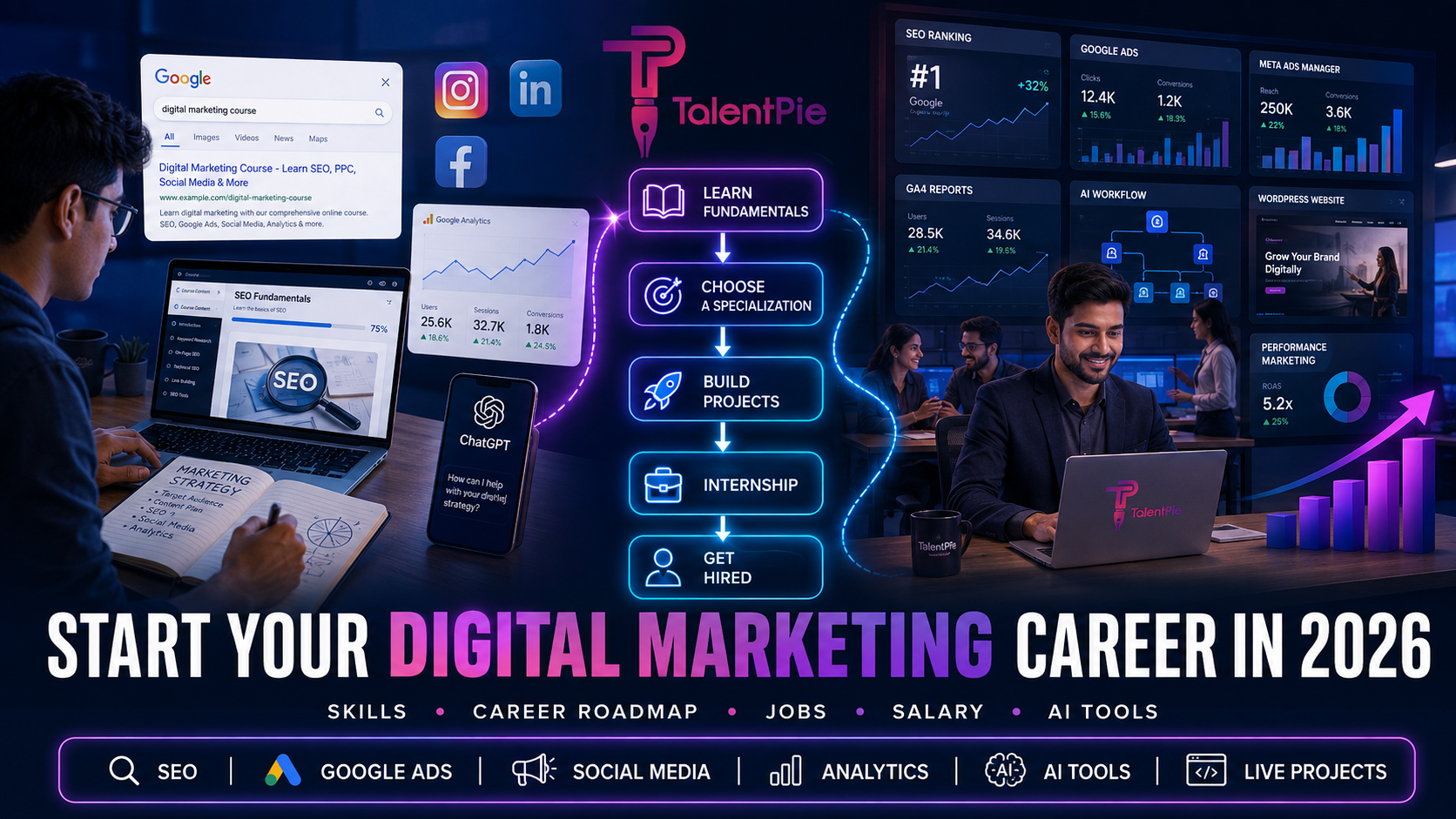
Quick answer: Starting a digital marketing career in 2026 means learning the fundamentals - SEO, content, social media, paid ads, and analytics - then picking one specialization to go deep on, learning the tools professionals actually use (including AI tools), and building a portfolio through real or simulated projects. Internships and entry-level roles come after you can show, not just tell, what you know.
Is Digital Marketing a Good Career in 2026?
Why Digital Marketing Is Growing in India
More Indian businesses are putting their growth online than ever before. E-commerce brands need performance marketers who can manage ad spend efficiently. D2C companies live or die by their content and social presence. Startups often can't afford large marketing teams, so they hire versatile generalists early on. Even local businesses - clinics, coaching centres, real estate agents - are investing in Google Business listings, local SEO, and WhatsApp-based lead generation.
This isn't a claim that every company needs an army of digital marketers. It's simply that the channels where customers spend their attention - search, social media, and increasingly AI-powered search - require someone on the business side who understands how to show up there. That's where the demand comes from.
Is Digital Marketing Still Worth Learning in 2026?
AI hasn't replaced digital marketers, but it has changed what a typical day looks like. Keyword research that once took hours can be sped up with AI tools. First drafts of ad copy or blog outlines can be generated in minutes. What AI can't do reliably is understand a specific business's audience, judge whether a campaign strategy actually fits the brand, or interpret why a metric moved and what to do about it.
That's the shift worth understanding: the marketers who are doing well in 2026 are the ones who combine AI-assisted speed with strategic thinking, creativity, and the ability to read data critically. If you're only learning "how to use ChatGPT for marketing" without learning marketing itself, you'll struggle to stand out. If you're learning marketing fundamentals and using AI as a tool rather than a crutch, you're in a strong position.
How to Start a Career in Digital Marketing in 2026
This is the part most guides gloss over. Here's a practical, step-by-step approach.
Step 1 - Learn Digital Marketing Fundamentals
Before specializing in anything, understand the basics that apply across every channel:
- How the customer journey works - awareness, consideration, decision, retention
- How to define and research a target audience
- What a marketing funnel is and how leads move through it
- The basics of branding and positioning
- An overview of SEO, paid advertising, social media, content, and analytics
You don't need to master all of these at once. You need enough working knowledge to understand how they connect, so that when you pick a specialization later, you understand where it fits into the bigger picture.
Step 2 - Choose a Digital Marketing Specialization
Trying to be equally good at everything is one of the most common beginner mistakes. It's more effective to build genuine depth in one area first.
|
Specialization |
Main Skills |
Common Roles |
|
SEO |
Keyword research, technical SEO, content optimization |
SEO Executive / SEO Specialist |
|
PPC |
Google Ads, Meta Ads, conversion tracking |
PPC Specialist |
|
Social Media |
Content planning, strategy, community management |
Social Media Executive |
|
Content Marketing |
Copywriting, SEO content, storytelling |
Content Strategist |
|
Analytics |
GA4, Google Search Console, reporting |
Marketing Analyst |
|
Performance Marketing |
Paid campaigns, CRO, ROAS optimization |
Performance Marketer |
Pick whichever aligns with your natural strengths - writers often gravitate to content, analytical thinkers to SEO or analytics, and people who enjoy fast iteration often do well in performance marketing.
Step 3 - Learn Industry Tools
Knowledge without tool familiarity doesn't translate into hireability. Some tools worth learning based on your specialization:
- Google Search Console and Google Analytics (GA4) - for tracking organic traffic, indexing, and user behaviour
- Google Ads and Meta Ads Manager - for running and optimizing paid campaigns
- SEMrush or Ahrefs - for keyword research and competitor analysis
- Canva - for basic creative and social media design
- WordPress - for understanding how content actually gets published and optimized on a website
- Spreadsheet tools (Excel/Google Sheets) - for reporting, budget tracking, and data analysis
- AI tools - for research, ideation, and speeding up repetitive tasks
You don't need premium subscriptions to start. Most of these tools have free tiers or trial versions that are enough to practice on.
Step 4 - Work on Real Projects
This is where most beginners fall short - they consume tutorials but never apply what they've learned. Practical experience means actually doing the work, even on a small scale.
For example, an SEO project might look like this: pick a real website (your own blog, a friend's small business site, or a non-profit that needs help)
→ do keyword research for their niche → identify content gaps and technical issues → optimize existing pages or write new content around target keywords → monitor performance in Google Search Console over a few weeks → document what changed and why.
A paid ads project could follow a similar arc: set up a small test campaign (even with a modest budget) → define audience targeting → set up conversion tracking → let it run → analyze ROAS and cost-per-lead → write up what worked and what you'd change.
A social media project: build a content calendar for a business's Instagram → create and schedule a month of posts → track engagement and reach → adjust based on what's performing → summarise the results.
These aren't hypothetical exercises for a course. They're real deliverables you can point to later.
Step 5 - Build a Digital Marketing Portfolio
A portfolio is where you turn scattered projects into proof of capability. A beginner portfolio might include:
- An SEO audit of a real or sample website
- A keyword research document with clear reasoning
- A content piece optimized for search, with the strategy behind it explained
- A small social media campaign with results
- A sample Google Ads campaign structure
- An analytics report interpreting GA4 or GSC data
- Before-and-after results from any project, however modest
Certificates tell an employer you sat through a course. A portfolio tells them what you can actually produce. In 2026's hiring environment, that difference matters more than it used to.
Step 6 - Get an Internship or Entry-Level Job
The typical progression looks like: Intern → Executive → Specialist → Senior Specialist → Manager. The pace varies a lot depending on the company, your specialization, and how quickly you pick up responsibility. Agencies often move faster because you're exposed to multiple clients and channels early; in-house roles at a single brand can offer deeper focus but sometimes slower exposure to variety.
Internships matter less for the stipend and more for what they teach you about working within real client or business constraints - budgets, deadlines, and stakeholders who don't always agree with your recommendations.
Step 7 - Keep Upskilling With AI and New Search Technologies
Digital marketing doesn't stay still, and 2026 is no exception. Areas worth paying attention to as you grow:
- AI-assisted content workflows and research
- Marketing automation and reporting tools
- Generative Engine Optimization (GEO) - optimizing content to be referenced by AI-powered search and chat tools
- Answer Engine Optimization (AEO) - structuring content to directly answer specific queries
- Shifts in how people search, including voice and conversational search
These are emerging areas rather than settled disciplines, so treat them as things to stay informed about and experiment with, not fixed skill sets to master overnight.
Skills Required for a Digital Marketing Career in 2026
SEO Skills
Keyword research, on-page SEO, technical SEO basics, link building fundamentals, local SEO, SEO analytics, content optimization, and understanding search intent.
Paid Advertising Skills
Google Ads and Meta Ads fundamentals, campaign structuring, audience targeting, bidding strategies, conversion tracking, understanding ROAS, and budget management.
Content Marketing Skills
Copywriting, storytelling, writing SEO-friendly content, content strategy, research skills, editing, and using AI tools to speed up (not replace) the writing process.
Social Media Marketing Skills
Platform-specific knowledge (Instagram, LinkedIn, YouTube), content planning, community management, and reading social analytics to inform what to post next.
Data & Analytics Skills
GA4, Google Search Console, spreadsheet proficiency, KPI tracking, conversion analysis, reporting, and connecting numbers back to business outcomes - not just reading dashboards, but explaining what they mean.
AI Skills for Digital Marketers
This deserves its own spotlight because it's the area changing fastest. Useful AI-related skills include:
- Using AI tools for content ideation and first drafts
- AI-assisted research and competitive analysis
- Prompt writing that gets useful, specific outputs rather than generic ones
- Automating repetitive reporting or workflow tasks
- Understanding AI-driven analytics tools
- Awareness of AI search visibility, including GEO and AEO concepts
Knowing how to prompt an AI tool isn't the same as being a marketer. The skill that actually matters is being able to evaluate AI output critically - knowing when it's right, when it's generic, and when it's simply wrong for your specific audience or brand.
Digital Marketing Career Paths and Job Roles in 2026
SEO Executive / SEO Specialist - Handles keyword research, on-page optimization, and technical SEO fixes. Good fit for people who enjoy research and long-term, measurable results.
Performance Marketing Specialist - Runs and optimizes paid campaigns across Google and Meta, focused on ROAS and conversions. Suits people comfortable with numbers and fast iteration.
Social Media Manager - Owns content strategy and community engagement across platforms. A good fit for creative thinkers who also want to understand analytics.
Content Marketing Specialist - Plans and writes content aligned with SEO and brand goals. Suits strong writers with an interest in strategy, not just execution.
PPC Specialist - Focuses specifically on paid search and display advertising, often going deeper into bid management and A/B testing than a generalist role would.
Digital Marketing Executive - A generalist entry-level role covering multiple channels, common at smaller companies or agencies where you wear several hats.
Marketing Analyst - Focuses on reporting, dashboards, and translating data into recommendations for the rest of the marketing team.
Digital Marketing Manager - A more senior role overseeing strategy, budgets, and a team, usually reached after a few years of specialist-level experience.
Freelance Digital Marketer - Works independently with multiple clients, requiring not just marketing skills but also client management and business development ability.
Digital Marketing Salary in India in 2026
Salary in digital marketing depends on several factors: location, years of experience, specialization, the hiring company, the strength of your portfolio, whether you're at an agency or in-house, and - increasingly - the results you can show from past work. Treat any number you see online, including the ones below, as indicative rather than guaranteed.
|
Experience |
Indicative Salary Range |
|
Fresher |
₹2.8–5 LPA |
|
1–3 years |
₹5–9 LPA |
|
3–5 years |
₹9–15 LPA |
|
5–8 years |
₹15–25 LPA |
Digital Marketing Salary for Freshers
Freshers typically start on the lower end of the range, with variation depending on city, company size, and whether they bring a portfolio of real projects to the table. A strong portfolio can sometimes offset a lack of formal experience.
Digital Marketing Salary After 2-3 Years
By this stage, specialization starts to matter more. Someone who can show consistent, measurable results in one area - say, performance marketing or SEO - tends to command a better range than a generalist with the same years of experience.
Digital Marketing Manager Salary
Manager-level compensation depends heavily on team size, company scale, and whether the role includes strategic ownership of budgets and outcomes, not just execution.
Freelance Digital Marketing Income
Freelance income varies more than salaried income and depends on the number of clients, your pricing structure, your niche, the services you offer, whether you work on retainers, and the results you deliver. There's no reliable "average" figure worth quoting here - it's genuinely case by case.
What Qualifications Do You Need to Become a Digital Marketer?
Do You Need a Degree for Digital Marketing?
Not necessarily. Many working digital marketers come from unrelated academic backgrounds - commerce, engineering, arts, and more. What employers care about is whether you can do the work, though a degree can still help in more traditional or larger organizations.
Can Students Start Digital Marketing?
Yes. Students often have more flexibility to experiment with content, run small paid campaigns, or manage social pages for college clubs or local businesses - all of which count as real experience.
Can You Become a Digital Marketer Without a Technical Background?
Yes. Digital marketing is more about strategic and analytical thinking than coding. Some technical SEO concepts help, but you don't need a programming background to succeed.
Do Certifications Matter?
They can help, but only as one part of the picture. A certification is evidence that you learned something. A portfolio and practical work are evidence that you can apply it. Employers increasingly weigh the second more heavily than the first - but a relevant certification alongside real project work is still a reasonable signal, especially for freshers with limited work history.
How to Get a Digital Marketing Job as a Fresher
Build 2–3 Practical Projects
Depth matters more than quantity. Two or three well-documented projects beat ten shallow ones.
Create a Portfolio
Compile your projects into a simple website, PDF, or even a well-organized Google Drive folder - anything that's easy for a recruiter to review quickly.
Optimize Your Resume
Lead with outcomes and specifics ("Ran a Google Ads test campaign, reduced cost-per-click by X%") rather than vague statements like "knowledge of digital marketing."
Improve Your LinkedIn Profile
Recruiters check LinkedIn before resumes in many cases. Keep it updated with your specialization, skills, and links to your portfolio.
Apply for Internships
Internships remain one of the fastest ways to get real-world exposure and references, even if the pay is modest at first.
Prepare for Digital Marketing Interviews
Be ready to talk through your projects in detail - what you did, why, what the results were, and what you'd change next time.
Before applying, a beginner should ideally be able to:
- Perform keyword research
- Conduct a basic SEO audit
- Explain GA4 and Google Search Console at a working level
- Explain basic Google Ads campaign concepts
- Create a simple content strategy
- Analyze campaign performance
- Explain what KPIs matter for a given goal
- Present project results clearly, in plain language
Digital Marketing Career Roadmap for Beginners
This is an example roadmap, not a guarantee. Your actual timeline depends on how much time you can dedicate, your prior knowledge, and how consistently you practice.
|
Stage |
Focus |
|
Month 1 |
Fundamentals |
|
Month 2 |
SEO + Content + Social Media |
|
Month 3 |
Ads + Analytics + AI |
|
Month 4 |
Projects + Portfolio |
|
Month 5 |
Internship / Practical Experience |
|
Month 6 |
Job Applications + Specialization |
Some people move faster if they're able to study full-time or already have related experience; others take longer while balancing college or a current job, and that's completely normal.
Job vs Freelancing vs Starting Your Own Agency
Digital Marketing Job
Offers structured learning, mentorship, steady income, and exposure to established processes. The trade-off is less control over the type of work you do, especially early on.
Freelancing
Offers flexibility and the ability to choose clients and niches, but income can be inconsistent at first, and you're responsible for finding your own work.
Starting a Digital Marketing Agency
Comes with the most autonomy but also the most responsibility - client acquisition, team management, and business operations, on top of the marketing work itself. This route generally suits people with some prior experience rather than absolute beginners.
Which Career Path Is Best for Beginners?
For most beginners, a job or structured internship is the more practical starting point - it builds skills and credibility with lower risk. Freelancing or starting an agency can make sense later, once you have enough experience and a track record to draw clients on your own.
Future of Digital Marketing in India
AI and Automation
Expect more repetitive tasks - reporting, first-draft content, basic research - to be automated, freeing up marketers to focus on strategy and creative decisions.
Search Is Changing
AI-powered search and chat interfaces are changing how people find information, which means visibility isn't only about ranking on a traditional search results page anymore.
Rise of Data-Driven Marketing
Decisions increasingly rely on real data rather than assumptions - testing, measuring, and adjusting rather than relying on a single fixed strategy.
Growing Importance of First-Party Data
As third-party tracking becomes more restricted, businesses are placing more value on data they collect directly from their own customers.
GEO and AI Search Optimization
Generative Engine Optimization is an emerging, still-evolving discipline focused on how content gets referenced by AI tools - worth watching, though best practices are still being established.
Why Human Skills Still Matter
Technology changes the tools, not the need for judgment. Understanding a business, its customers, and what actually motivates a purchase decision is still fundamentally a human skill - one that combines technology, strategy, creativity, data, and communication.
Common Mistakes Beginners Make in Digital Marketing
- Trying to learn every specialization at once instead of going deep in one
- Watching tutorials without ever applying what's taught
- Skipping practical projects entirely
- Ignoring analytics and only focusing on creative output
- Depending entirely on AI without understanding the underlying marketing logic
- Collecting certificates instead of building demonstrable skills
- Never putting together a portfolio
- Expecting a high salary immediately, without first building a track record
Is Digital Marketing a Good Career for You?
Digital marketing tends to suit people who enjoy a mix of creativity and analysis - writing and designing on one hand, reading data and testing hypotheses on the other. If you enjoy experimenting, learning new tools, and adjusting your approach based on results, you'll likely find the field engaging.
It can feel frustrating, though, for people who dislike continuous learning or don't enjoy having their work measured constantly. Digital marketing is a field where performance is visible in numbers - clicks, conversions, engagement - and not everyone finds that comfortable.
Frequently Asked Questions About Digital Marketing Careers in 2026
1.Is digital marketing a good career in 2026?
Yes, for people willing to build practical, demonstrable skills rather than relying only on certificates. Demand remains strong across e-commerce, D2C brands, startups, and local businesses, though hiring has become more selective and portfolio-focused.
2.How can I start a career in digital marketing?
Learn the fundamentals across SEO, content, social media, ads, and analytics, then pick one specialization to go deep on. Learn the relevant tools, work on real or simulated projects, build a portfolio, and apply for internships or entry-level roles.
3.What skills are required for digital marketing in 2026?
Core skills include SEO, paid advertising, content marketing, social media management, and data analytics. AI literacy - using tools effectively while evaluating their output critically - has become an additional, increasingly important skill.
4.What is the salary of a digital marketer in India in 2026?
Salaries vary widely by experience, specialization, location, and company. Indicative ranges run from roughly ₹2.8–5 LPA for freshers up to ₹15–25 LPA for professionals with 5–8 years of experience, though actual compensation depends on many factors.
5.Can I become a digital marketer without a degree?
Yes. Many successful digital marketers come from non-marketing academic backgrounds. Employers generally prioritize demonstrable skills and a portfolio over formal educational credentials.
6.Which digital marketing skill is most in demand in 2026?
There isn't a single "most in demand" skill - performance marketing, SEO, and data analytics are all consistently sought after, and AI literacy has become a valuable addition across every specialization.
7.Is digital marketing a good career for freshers?
Yes, particularly because entry-level roles exist across agencies, startups, and in-house teams. Freshers who build even a small portfolio of real projects tend to stand out during hiring.
8.How long does it take to learn digital marketing?
It depends on the person - how much time they can dedicate and how consistently they practice. A structured beginner roadmap often spans a few months for fundamentals and specialization, followed by ongoing learning throughout your career.
9.What are the best digital marketing jobs for freshers?
Roles like Digital Marketing Executive, SEO Executive, and Social Media Executive are common entry points, since they typically involve execution-level work under some supervision.
10.Is digital marketing still relevant after AI?
Yes. AI has changed workflows, not eliminated the need for marketers. Professionals who combine AI tools with strategic thinking, creativity, and data interpretation remain in demand.
11.Should I learn SEO or paid advertising first?
Either is a reasonable starting point - it depends on your interests. SEO suits people who enjoy research and long-term thinking, while paid advertising suits people who like faster feedback loops and testing.
12.Is digital marketing better as a job or freelancing career?
For most beginners, a job or internship offers more structured learning and lower risk. Freelancing can be a strong option later, once you have experience and a portfolio to attract clients independently.
Conclusion
A successful digital marketing career in 2026 isn't built by collecting certificates - it's built through strong fundamentals, one well-developed specialization, genuine practical experience, and comfort working alongside AI tools rather than depending entirely on them. Add analytics literacy and a portfolio that shows real work, and you're in a strong position regardless of your starting background.
If you prefer structured, hands-on learning instead of piecing everything together on your own, a practical digital marketing training program can help you build these skills through guided projects and mentorship. TalentPie's Digital Marketing Course in Noida is built around exactly this kind of practical, industry-focused approach for people starting out.